Build, Buy or Partner? A Layered Guide to AI Feedback Analytics
Guide for businesses in deciding how to implement AI for customer feedback analysis, moving beyond a simple "build or buy" choice to a layered approach
AI-powered sentiment analysis software like Thematic analyzes thousands of social media posts in minutes, revealing how customers feel about your brand.
Social media sentiment matters because 50%+ of users research products on these platforms, and negative posts can damage reputation within hours.
Modern sentiment analysis tools use Large Language Models to understand context, sarcasm, and slang that traditional rule-based systems miss.
Thematic combines sentiment analysis with thematic analysis, showing not just how customers feel but which specific topics drive emotions.
Enterprise platforms unify social media sentiment with surveys, reviews, and support tickets for transparent, multi-channel analysis.
Over 50% of social media users research products on these platforms. A negative tweet or scathing TikTok review can make or break a brand.
You're monitoring social media mentions, but manual analysis takes weeks. By the time you spot patterns, the damage is done. Meanwhile, competitors who analyze sentiment in real-time respond faster and protect their reputation.
AI-powered sentiment analysis software changes this. Tools like Thematic process millions of social media posts automatically, revealing the emotions behind customer interactions. You see not just what people say, but how they feel and why.
This guide covers what social media sentiment analysis is, why it matters, and how to implement it. You'll learn about the best tools available and how combining sentiment with thematic analysis delivers deeper insights than sentiment scores alone.
Here's what you need to know about analyzing social media sentiment:
What is social media sentiment analysis?
Social media sentiment analysis uses AI to determine the emotional tone behind posts, comments, and conversations on platforms like Twitter, Facebook, Instagram, and TikTok.
The goal is classifying sentiment as positive, negative, or neutral. This reveals customer attitudes and emotions hidden in unstructured social media text.
Sentiment analysis is a form of text analytics using AI methods. Traditionally, sentiment analysis was automated using natural language processing (NLP) and machine learning. Most recently, Large Language Models (LLMs) such as ChatGPT have been successfully applied to this task.
Sentiment analysis can be combined with thematic analysis, which identifies patterns and themes in qualitative data. This combination reveals how customers feel about specific topics like customer support interactions or product features.
Thematic is AI-powered sentiment analysis software that combines sentiment scoring with automatic theme discovery. Unlike tools that only report emotional tone, Thematic shows which specific topics drive positive or negative sentiment in your social media feedback.
Thematic
AI-powered software to transform qualitative data into powerful insights that drive decision making.
Social media sentiment matters because customers expect fast responses, share unfiltered opinions publicly, and influence purchase decisions through their posts.
Understanding sentiment helps you protect brand reputation, improve customer experience, and make data-driven business decisions.
1. Better brand management
A single negative incident posted on TikTok or Instagram spirals quickly into PR crisis and damages brand reputation.
Social media sentiment analysis lets you monitor brand perception in real-time. You identify issues as they emerge and respond promptly.
Customers expect fast responses on social media. According to a recent McKinsey report, 79% of consumers expect brands to respond within 24 hours and 40% expect an answer within the hour. This is especially true for complaints and negative feedback.
Example of social media sentiment analysis for brand management
Nike's partnership with Colin Kaepernick was controversial. But Nike had analyzed sentiment data showing their core customers—mostly younger Americans—supported the message.
They released their Nike Dream Crazy ad on YouTube rather than traditional channels. Nike monitored social media sentiment during the campaign, tracking public reactions in real-time.
Customers share unfiltered feedback on social media more readily than in direct surveys or customer service channels. Social media sentiment analysis complements Voice of Customer programs by capturing authentic opinions customers won't share elsewhere.
These comprehensive insights improve customer satisfaction and retention.
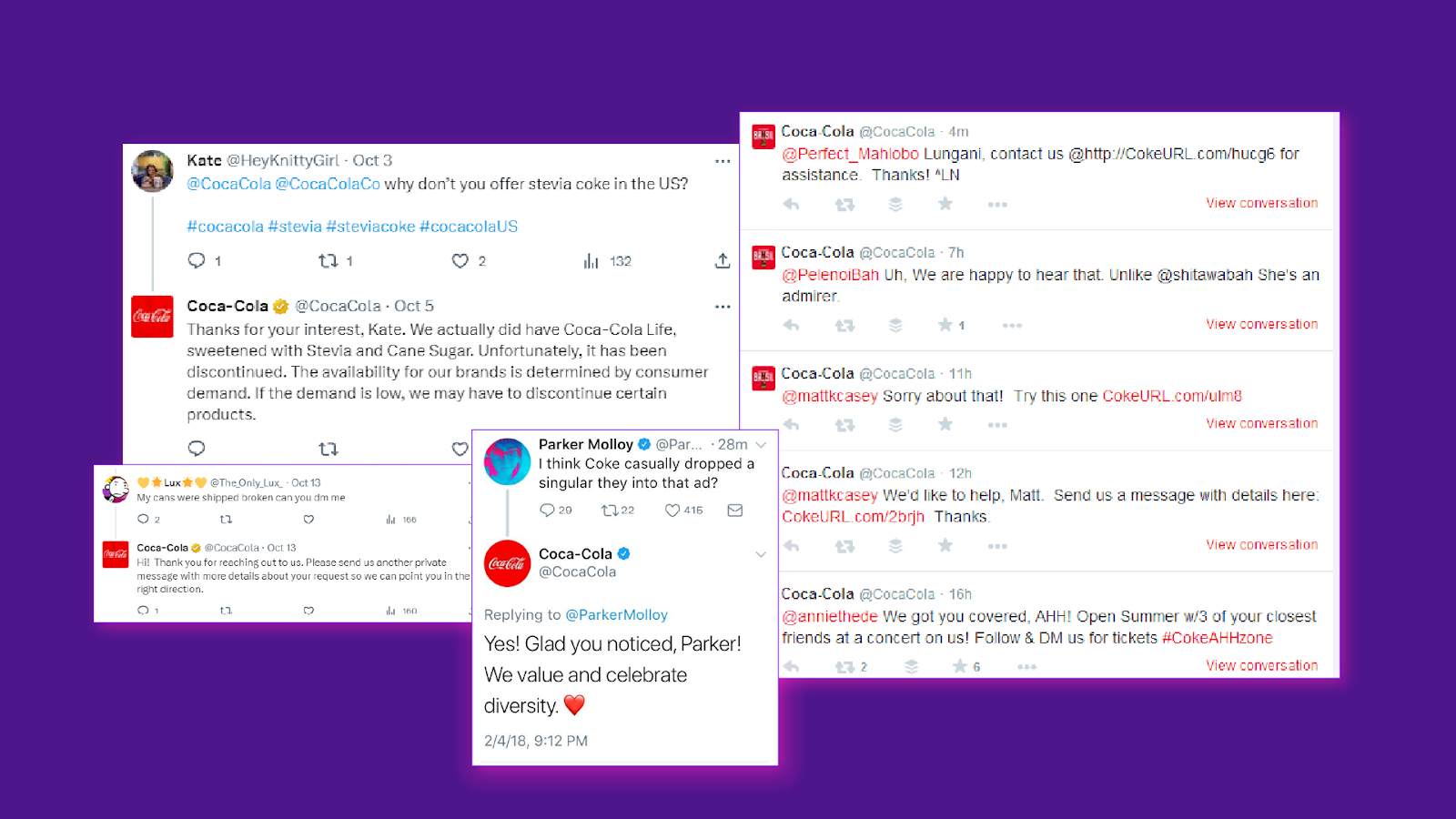
Example of social media sentiment analysis for understanding customer feedback
Coca-Cola takes social media sentiment analysis seriously. The company monitors negative mentions to identify emerging issues customers discuss.
Customers might complain about packaging, communications, or major innovations like the controversial New Coke. Coca-Cola moves swiftly to fix issues before they escalate.
3. Gaining actionable insights
Organizations using customer data to drive decisions are 23 times more likely to acquire customers than competitors, according to McKinsey. They're also 19 times more likely to achieve above-average profitability.
Social media sentiment analysis delivers big-picture insights into market trends and customer preferences. This enables companies to adjust product development, marketing strategies, and business decisions in ways that move the needle.
Tracking social media sentiment around competitors helps identify opportunities to outperform them or gaps in the market.
Example of social media sentiment analysis for actionable insights
Brands launching new products track real-time social media reactions to monitor campaign reception. High negative feedback triggers quick response or messaging adjustments.
Thematic combines AI-powered qualitative analysis with quantitative data integration, turning millions of customer comments into measurable insights you can track against business metrics like NPS or CSAT.
How does social media sentiment analysis work?
Social media sentiment analysis uses AI to determine whether posts, comments, and conversations express positive, negative, or neutral emotions.
Traditional methods relied on simple keyword rules. Modern LLMs like ChatGPT interpret context, sarcasm, and slang, making analysis far more accurate.
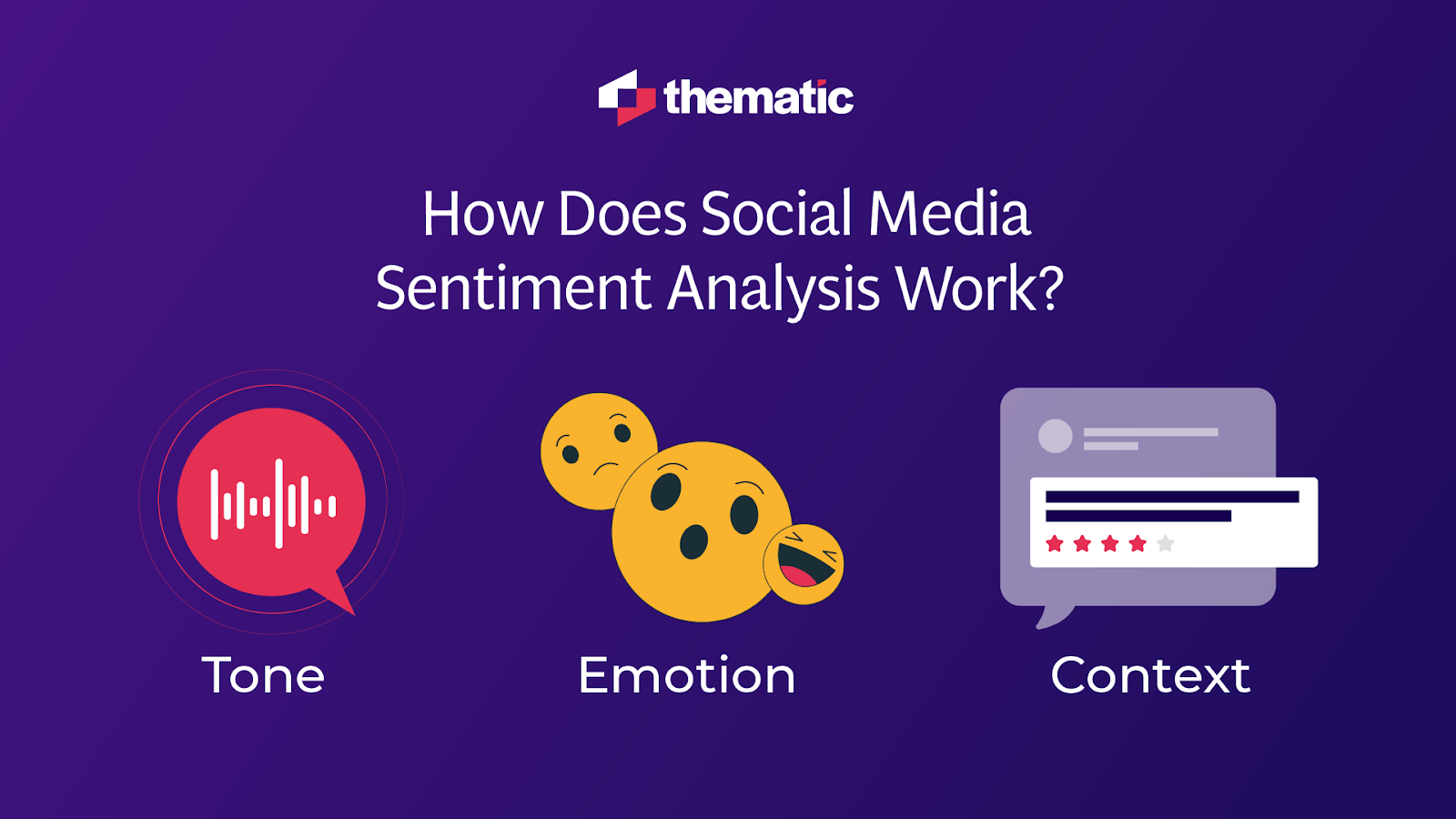
Tone: The overall tone gets graded as positive, negative, or neutral. Words like "love" or "hate" make emotion easier to detect, but they mislead when there are double negatives, jokes, or sarcasm.
Emotion: Emotion analysis recognizes a wider range of feelings like happiness, anger, surprise, or disgust beyond basic positive/negative/neutral classification.
Context: Context is crucial for understanding sentiment, especially with informal social media language. "This is sick!" could be positive or negative depending on usage. Large Language Models (LLMs) consider the entire sentence and surrounding posts to determine true meaning.
The process begins with selecting and gathering data from Twitter, Facebook, Instagram, and other platforms. There are two primary methods:
APIs (Application Programming Interfaces) work like data faucets that automatically pull public posts and comments. Twitter's API lets you extract tweets based on hashtags, keywords, or specific users.
Web Scraping uses automated scripts to pull data directly from web pages when APIs aren't available. Web scraping gathers large data volumes but requires care to avoid violating platform terms of service.
2. Data Preprocessing
Raw social media data is noisy. It contains hashtags, links, mentions, and emojis that need preprocessing for accurate sentiment analysis. AI sentiment analysis tools handle this automatically:
Removing irrelevant elements strips out URLs, special characters, mentions (like @usernames), and hashtags that don't add sentiment value
Converting emojis and slang translates these important sentiment indicators to corresponding meanings. For example, "😊" indicates positive sentiment
Tokenization breaks text into smaller chunks called tokens. The sentence "I love this product!" becomes ["I," "love," "this," "product"]
Lemmatization or Stemming reduces words to base form. "Running" becomes "run," making it easier to match words and detect patterns
3. Sentiment Scoring
Machine learning models trained on vast datasets determine whether tokens indicate positive, negative, or neutral sentiment. Modern AI-powered sentiment analysis tools factor in emojis and images too.
AI sentiment analysis tools vs. traditional sentiment analysis
Traditional sentiment analysis used rules to categorize sentiment. For example: "if a sentence contains the word 'great', then the sentiment is positive."
These rules have limitations. Applied to complex text, they fail to capture nuanced sentiment:
Using LLMs for sentiment analysis
Large Language Models (LLMs) have superseded traditional approaches. Instead of providing training data, you write a prompt. LLMs created a universal model applicable to many language understanding and generation tasks.
Large Language Models offer better accuracy compared to traditional solutions. They require careful prompt engineering, are slower for some applications, and can be costly.
Using ChatGPT for sentiment analysis
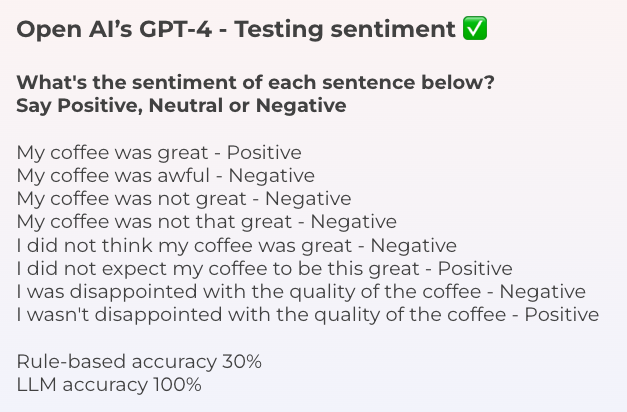
LLMs outperform traditional rule-based sentiment analysis. We tested the sentences above through ChatGPT:
Testing how accurate LLMs like ChatGPT when performing sentiment analysis.
AI analytics tools like Thematic use large language models (LLMs) such as GPT-4 with proprietary algorithms. This makes it faster to get specific, reliable answers and valuable insights.
Unlike black-box AI tools, Thematic provides transparent, research-grade analysis. You can edit, refine, and validate how themes are built using the Theme Editor, combining AI speed with human-in-the-loop accuracy.
The challenges of social media sentiment analysis
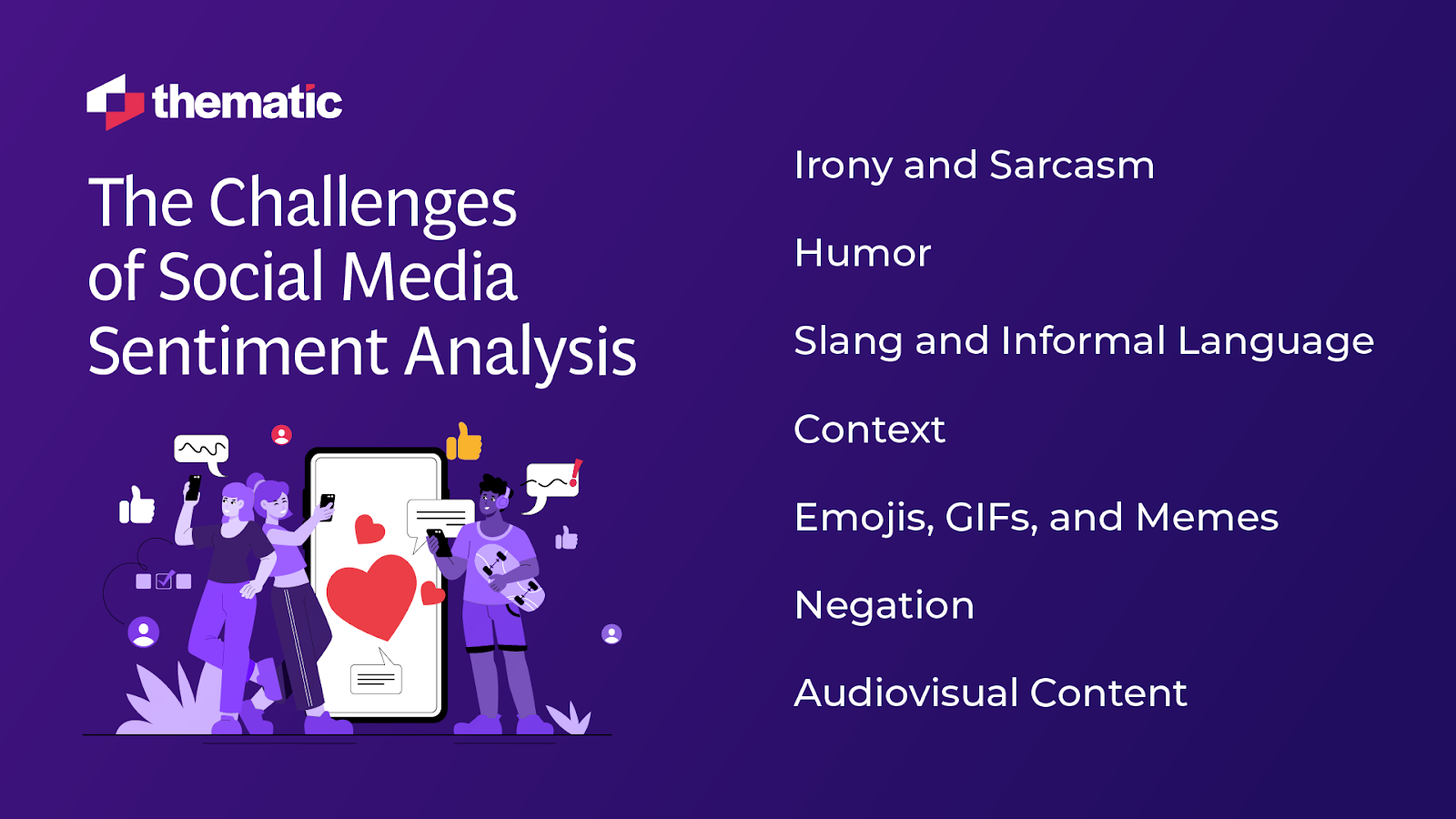
Social media sentiment analysis faces five major challenges: sarcasm, humor, slang, context, and visual content.
These elements make it difficult even for humans to understand sentiment. Context changes quickly, and something that seems positive in one post might actually be negative when you examine it closely.
Irony and Sarcasm
With irony and sarcasm, people use positive words to describe negative experiences (or vice versa). AI struggles to understand the underlying sentiment.
"Oh great, another Monday!" might sound positive at first but conveys frustration. Traditional rule-based sentiment analysis tools misclassify this as positive because they rely on literal word meaning.
Humor
Humor involves nuanced meanings at odds with surface content. A jokey tweet misleads basic sentiment analysis algorithms.
Humor relies on cultural knowledge, double meanings, or playfulness. Algorithms struggle to pick up on these and gauge correct sentiment.
Slang and Informal Language
Slang is challenging for social media analysis. Traditional NLP models may not understand latest language trends.
Words like "lit" or "fire" may not categorize correctly. The same applies to hashtags, abbreviations, multilingual posts, and region-specific expressions.
Context
Context is crucial for understanding sentiment. Opinion words change polarity depending on context.
"Sick" is negative in "I feel sick" but positive in "That car is sick!" Machines need to learn context to correctly classify text.
This applies to posts that are part of wider conversations the algorithm may miss. Social media posts are often short due to character limits, leaving little room for detailed context and making it harder to capture underlying meaning.
Emojis, GIFs, and Memes
Emojis and GIFs are almost their own language on social media. We use them to express complex emotions or meanings linked to contexts that can't easily translate into text.
Tools need multi-modal analysis (analyzing both text and images) to better understand sentiments expressed through these forms.
Negation
Negation creates problems for traditional sentiment analysis models. "I can't not buy another Apple Mac" states a positive intention.
In the past, training models to recognize such nuances was difficult. Today, LLMs recognize them with ease.
Audiovisual Content
Video and audio are different data types from text. Audio alone or as part of videos needs transcription first using speech-to-text algorithms. Sentiment analysis can then analyze transcribed text like any other text.
Top tools for social media sentiment analysis
Advanced sentiment analysis tools go beyond simple rules-based categorization. Comprehensive sentiment analysis software handles complex linguistic structures, makes sense of context, and deals with unique social media features like hashtags and audiovisual content.
Thematic
Thematic specializes in advanced thematic and sentiment analysis powered by AI. Thematic automatically identifies themes in your feedback and layers this with sentiment analysis.
Key Features
Thematic handles large volumes of unstructured data from sources like surveys, social media, and reviews. This makes it ideal for businesses with extensive customer interactions who want to analyze all their data in one place.
Thematic offers robust customization so organizations can tailor sentiment analysis to their specific needs and industry contexts. You create custom themes based on unique feedback for greater relevance and accuracy.
Thematic leverages Generative AI to continuously improve accuracy and adapt to evolving language patterns. This is especially relevant for social media sentiment analysis where language use constantly shifts.
💡
Thematic Expert Tip: Set Alerts for Urgent Issues
One of Thematic's unique features is alerting you to new problems your teams were unaware of and urgently escalating issues. For example, you could set up email or Slack alerts for social media posts mentioning specific categories like 'data breach' or 'privacy'.
Limitations
Thematic does not offer granular emotion analysis beyond positive, neutral, and negative sentiment.
Pricing
Thematic offers a free guided trial so you can try the platform using your own data. Rates for larger enterprises are flexible and customized depending on comment volumes and datasets.
AI-Powered Sentiment Analysis Software
See How Thematic Analyzes Social Media Sentiment at Scale
Brandwatch specializes in social media monitoring. The platform helps businesses track and analyze online conversations around their brand in real-time, including social media platforms, blogs, and news sites.
Key Features
Brandwatch offers real-time sentiment tracking, customizable dashboards, historical data analysis, and competitive benchmarking. A major advantage is that Brandwatch gathers data from many different sources, giving you a comprehensive look at online chatter about your organization.
Limitations
G2 reviewers report it can take a long time for data to load, especially after updating queries. Connecting the platform with other tools and channels can be challenging.
Pricing
Brandwatch offers several pricing plans ranging from standard users to enterprise clients. Some G2 reviewers report the platform is more expensive compared to other social listening tools.
Sprout Social
Sprout Social offers robust social media management features alongside sentiment analysis. You can use it for everything from scheduling posts and identifying influencers to monitoring brand reputation on social media.
Key Features
Sprout Social's software makes it easy to build queries tracking social media conversations without technical knowledge. Their Sentiment Summary and Sentiment Trends metrics show how people feel about your brand on social media, while the sentiment analysis widget tracks positive, negative, and neutral mentions over time.
Other useful features include Share of Voice (SOV) tracking, custom alerts, and "Word Cloud" visualizations highlighting top trending keywords and hashtags associated with your chosen topic.
Limitations
G2 reviewers report issues with missing data and difficulties connecting social media channels to the site.
Pricing
Sprout Social offers a 30-day free trial to new users. After that, pricing plans range from $199 to $399 per seat per month depending on features needed. Custom plans are available for larger enterprises.
Hootsuite Insights
Hootsuite is a social media management tool offering sentiment analysis and social listening. They claim to have the most comprehensive social listening coverage on the market.
Key Features
Hootsuite provides real-time data and integrates seamlessly with major social platforms. Their proprietary Blue Silk AI was designed specifically for social media.
You monitor brand mentions with the Quick Search tool, which searches the web in real-time. Results are color-coded by sentiment for easy understanding at a glance.
Limitations
G2 reviewers report Hootsuite's analytics capabilities are limited without the advanced plan. The platform can run slow and be cumbersome to use.
Pricing
Hootsuite offers a 30-day free trial. After that, choose between Professional membership for individuals, a Team plan for 3 users, or a custom Enterprise plan for larger organizations.
Implementing social media sentiment analysis
Implementing social media sentiment analysis requires three steps: choosing the right tool, setting up monitoring, and analyzing data.
Here are the practical steps to get started:
Step 1: Pick the right tool
Dozens of sentiment analysis tools exist, from basic free options to advanced AI-powered solutions. Simple tools suffice for small one-off projects, while larger organizations with bigger datasets need comprehensive platforms with greater reporting and analytics capabilities.
Questions to ask when choosing a social media sentiment analysis tool:
Which platforms do you need? Make sure the tool integrates with social channels where your audience hangs out.
Can it handle multiple languages? You might need these capabilities depending on your audience.
How customizable is it? Look for tools that let you tweak settings or add your own keywords.
Does it offer real-time updates? This is crucial for crisis management or quick response needs.
How advanced are the analytics capabilities? Traditional rules-based tools are less accurate than those using LLMs. Consider whether you need a highly-accurate tool for huge data volumes or whether a simpler solution will do.
Step 2: Set up your data monitoring
Setting up data monitoring is like tuning a radio. You want to lock in on the right frequencies (keywords, hashtags, and mentions) to get the clearest picture of your brand.
How to setup social media sentiment analysis monitoring:
Pick Your Keywords & Hashtags: Identify keywords, hashtags, and phrases people use when talking about your brand, products, competitors, or industry.
Monitor Competitors: Track what people say about your competitors too. This gives insights into market gaps and helps spot industry trends.
Set Up Alerts: Make sure your tool notifies you of significant sentiment shifts. A sudden uptick in negative feedback on a specific topic could signal an emerging issue.
Step 3: Analyze and interpret your data
Start analyzing and interpreting your data. The easiest way is using a comprehensive AI tool like Thematic that automatically identifies themes in your data and summarizes underlying sentiment.
Interpreting your data with social media sentiment analysis:
Summarize Overall Sentiment: Are people talking positively or negatively about your brand? Look for changes over time and monitor how and why brand reputation fluctuates.
Analyze Sentiment by Topic: Combine thematic and sentiment analysis to dive deeper into specific topics. This shows which aspects of your business customers are most upset or happy about.
Trending Phrases: What are the most talked-about words and phrases? These show what's important right now for your audience and help inform future business decisions.
Best practices for social media sentiment analysis
Context is everything
A comment like "this product is sick" could be positive or negative depending on context. Always look beyond the sentiment score and consider context.
More advanced AI-powered tools using LLMs give more accurate results by understanding context automatically.
Customize the tool
Advanced tools often let you customize and fine-tune according to specific business needs.
With Thematic, you add, merge, and delete themes using the Theme Editor. This improves accuracy and gives you insights that better inform business goals.
Combine qualitative and quantitative data
Quantitative data like overall sentiment scores are useful for measuring brand reputation temperature. But for added value, combine them with qualitative insights from your data.
Read through associated comments and posts to understand exactly what customers say and what issues need addressing.
How Thematic can help you analyze customer feedback beyond social media
Here's how you use Thematic to analyze everything from social media posts and online reviews to support tickets and emails:
Step 1: Upload Your Data
Thematic's wide range of one-click integrations make it easy to connect all your channels. These include Qualtrics, Trustpilot, Amazon, Facebook, Intercom, Twitter, TripAdvisor, and many more.
Thematic automatically cleans and prepares your data so it's ready for analysis.
Step 2: Analysis
Thematic analysis using Thematic
Thematic's AI automatically groups themes into a 2-level taxonomy. For given text, there are core themes and related sub-themes.
The image below shows top themes for a dataset and sub-themes displayed below these:
Sentiment Analysis using Thematic
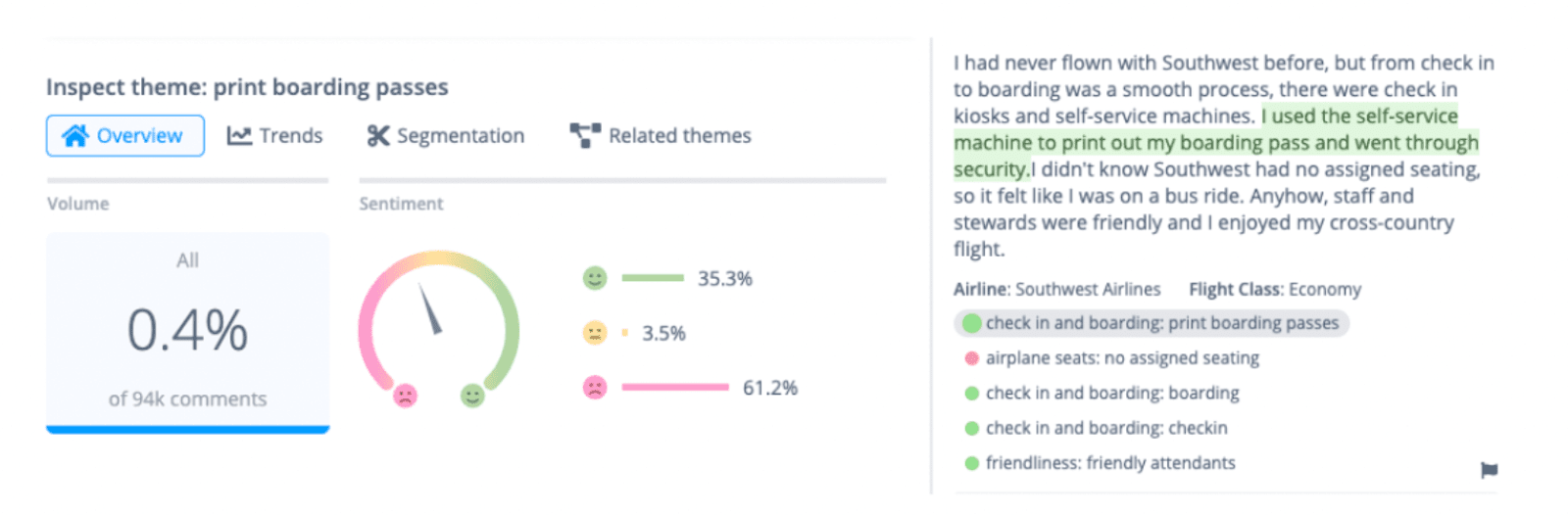
Thematic uses sentiment analysis with thematic analysis to help you understand the emotion behind a theme. Sentiment analysis scores each piece of text or theme and assigns positive, neutral, or negative sentiment.
The example below shows the theme "print boarding passes." Thematic enables you to dig deeper and understand how customers feel about this topic using sentiment scores.
In this case, Southwest's lack of assigned seating is associated with negative sentiment:
Step 3: Sentiment Analysis + Metrics
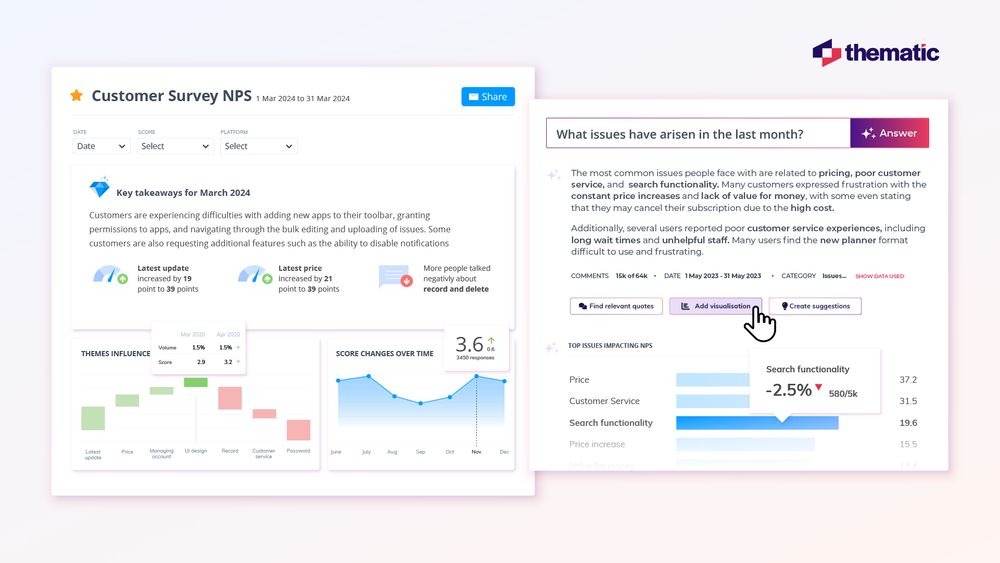
Thematic and sentiment analysis together help you better understand key customer metrics like NPS.
The example below shows key themes impacting NPS and monitors the degree of impact they have on the score. You can also track this over time to see how efforts to improve certain issues have impacted NPS:
This feature is especially useful for sharing valuable insights with key stakeholders. Clear visualizations get your message across easily, making it simple for stakeholders to understand at a glance what influences key business metrics.
Step 4: AI + Human
Another handy feature of Thematic is the ability to make manual tweaks to your analysis. This approach incorporates both AI capabilities and human validation to ensure greater accuracy.
You use the Theme Editor to delete, edit, merge, or create new themes. This is useful when you have themes not relevant to your organization.
Summary
Social media sentiment analysis uses AI to understand how customers feel about your brand based on their posts, comments, and conversations across platforms.
A single negative post can spiral into crisis. Customers expect responses within 24 hours. Traditional manual analysis takes too long.
AI-powered sentiment analysis software changes this. Modern tools using Large Language Models understand context, sarcasm, and slang that rule-based systems miss. They process thousands of posts in minutes, revealing patterns and emotions hidden in unstructured social media text.
The most valuable approach combines sentiment analysis with thematic analysis. Sentiment scores tell you how customers feel. Thematic analysis tells you why. Together, they reveal which specific topics drive positive or negative emotions in your social media feedback.
Enterprise sentiment analysis platforms like Thematic sit on top of existing tools like Medallia or Qualtrics, unifying qualitative and quantitative data for transparent, defensible analysis that executives trust.
Social media sentiment analysis helps you protect brand reputation, understand customer feedback, and make data-driven decisions. The organizations that analyze sentiment in real-time respond faster, improve customer experience, and outperform competitors who still analyze feedback manually.
Try Thematic on your data
Still not sure which social media sentiment analysis tool is right for you? The best way to find out is trying them yourself.
Start with a free guided demo of Thematic using your own data. See how combining sentiment with thematic analysis reveals not just how customers feel, but which specific topics drive those emotions.
Thematic delivers transparent, research-grade analysis at enterprise scale. Book a guided trial and see how AI-powered automation combined with human-in-the-loop control transforms social media feedback into confident decisions. Book your guided trial
Frequently asked questions (FAQs)
1. What is the best tool for social media sentiment analysis?
Thematic is AI-powered sentiment analysis software that analyzes social media posts at scale, combining sentiment scoring with thematic analysis to reveal both how customers feel and why. Unlike basic tools that only report emotional tone, Thematic shows which specific topics drive sentiment.
2. How do AI sentiment analysis tools work?
AI sentiment analysis tools use Large Language Models to interpret tone, context, and emotion in text. Modern tools like Thematic combine LLMs with custom algorithms for faster, more accurate results. They automatically collect social media data, preprocess it to remove noise, then score sentiment while identifying themes.
3. Can sentiment analysis tools analyze social media posts?
Yes. AI-powered sentiment analysis software analyzes social media posts at scale, processing thousands of comments in minutes. Advanced tools like Thematic handle unique social media challenges including sarcasm, slang, emojis, and context that traditional rule-based systems miss through Large Language Model technology.
4. What tool combines sentiment analysis with thematic analysis?
Thematic uniquely combines sentiment analysis with thematic analysis, automatically identifying themes in feedback while scoring emotional tone. This reveals not just how customers feel, but what specific topics drive sentiment. The combination delivers deeper insights than sentiment scores alone provide.
5. How accurate is AI sentiment analysis for social media?
AI sentiment analysis using LLMs achieves higher accuracy than traditional rule-based tools. Thematic adds transparent, human-in-the-loop control where researchers can validate and refine AI-generated themes for research-grade accuracy. This combination delivers reliable sentiment analysis even for complex social media language.
6. Can you analyze sentiment across multiple social media platforms?
Yes. Enterprise sentiment analysis platforms like Thematic unify social media data with surveys, reviews, and support tickets, delivering sentiment analysis across all customer feedback channels in one transparent platform. One-click integrations connect Twitter, Facebook, Instagram, and more for unified analysis.
7. What's the difference between sentiment analysis and thematic analysis?
Sentiment analysis measures emotional tone (positive, negative, neutral) while thematic analysis identifies topics and patterns. Combining both reveals what customers discuss and how they feel about each topic. This combination delivers more actionable insights than sentiment scores alone.
8. How do I choose a social media sentiment analysis tool?
When choosing sentiment analysis tools, prioritize platforms using LLMs over rule-based systems, multi-channel integration capabilities, real-time monitoring, customization options, and transparent methodology that lets you validate AI findings. Consider your data volume, budget, and whether you need research-grade accuracy.
9. Why does social media sentiment matter for businesses?
Social media sentiment matters because 50%+ of users research products on these platforms, customers expect responses within 24 hours, and negative posts can damage reputation quickly. Analyzing sentiment helps protect brand reputation, understand unfiltered customer feedback, and make data-driven decisions that improve customer experience.
10. Can sentiment analysis tools handle sarcasm and slang?
Modern AI sentiment analysis tools using Large Language Models handle sarcasm, slang, and context that traditional rule-based systems miss. Thematic's AI interprets informal language, emojis, and nuanced meanings by considering full context. However, accuracy varies by tool—LLM-based platforms significantly outperform rule-based systems.
Share
Link Copied!
Request a demo of Thematic's Customer Intelligence Platform
Thematic turns fragmented feedback into one consistent source of customer truth — so every team acts on the same customer story. Up and running in days, not quarters.
Thank you! Your submission has been received!
Oops! Something went wrong while submitting the form.

.webp)