What Tool Links Feedback Themes to NPS or CSAT Drivers?
Surfacing themes is only half the job. Learn how Thematic's Impact Analysis automatically connects feedback themes to NPS, CSAT, and other outcome metrics, and how the Scoring Agent fills in the gaps when standard survey data isn't enough.
Build, Buy or Partner? A Layered Guide to AI Feedback Analytics
Guide for businesses in deciding how to implement AI for customer feedback analysis, moving beyond a simple "build or buy" choice to a layered approach
Thematic is the customer intelligence platform built to connect feedback themes directly to NPS, CSAT, and other outcome metrics. With Impact Analysis, automatically calculates how much each theme lifts or drags your score.
The Scoring Agent creates custom metrics from unstructured feedback.
Every finding comes with full audit trails so you can defend the numbers in any boardroom.
You're surfacing themes. You know customers mention "billing confusion" or "slow onboarding," but you can't tell how much those themes are actually moving your NPS. That gap between qualitative themes and quantitative outcomes is exactly what Thematic's customer intelligence platform is built to close.
The answer to "what tool does this" is Thematic. Specifically, its Impact Analysis feature automatically correlates every feedback theme with NPS, CSAT, retention, revenue, or any other metric you care about.
For each theme, you see the direction of impact, the magnitude in score points, and how that breaks down across segments. Most feedback tools stop at identifying themes. Impact Analysis goes further by quantifying the business consequence of each one.
According to McKinsey, only 15% of CX leaders are fully satisfied with how their company measures CX. The missing piece is usually the connection between what customers say and what the numbers show. That's the problem Impact Analysis solves.
How Impact Analysis connects themes to NPS drivers
Thematic calculates the correlation between each theme and your outcome metric automatically, as new feedback arrives. You don't set up rules or tag training data. The AI discovers the themes from your feedback and attaches the metric impact to each one.
Orion Air, a low-cost carrier in the Asia-Pacific region, used this to link specific touchpoints to NPS changes across their operation. Their insights team found that baggage handling issues, while not the most frequently mentioned topic, had a disproportionate impact on NPS and customer lifetime value.
With 80% of those issues operationally fixable, they made targeted changes and saw a 1.6-point NPS improvement from that single touchpoint alone, contributing to a 13% overall NPS increase.
As their insights lead put it: "What's remarkable isn't just that we improved NPS. It's that we became more efficient in the process. Thematic helped us invest smarter, not just more."
That's the difference between knowing themes exist and knowing which ones to act on first.
How the Score Change waterfall explains metric shifts
Impact Analysis doesn't just show the current state. It explains movement over time through the Score Change waterfall, which reconciles every NPS shift mathematically across themes.
If your NPS dropped 3 points last quarter, the waterfall breaks that down precisely: shipping delays cost 5 points, improved support recovered 2, net result is negative 3. Every movement is accounted for.
You can walk into an executive review with a clear, defensible explanation of what drove the change, not just the number itself. A Fortune 500 networking company described the output as "most defendable insights we've ever presented to executives."
This is what separates customer intelligence from traditional reporting. Reporting tells you what happened. Customer Intelligence and Activation tells you why, and what to do next.
How the Scoring Agent extends beyond standard metrics
Not every metric you need exists in your survey data. The Scoring Agent generates custom scores for VoC outcome metrics directly from unstructured feedback text, things like perceived trust, churn risk, release quality, or upsell readiness.
These scores link directly to the themes driving them, so when a "trust" score drops, you can see exactly which feedback themes are pulling it down.
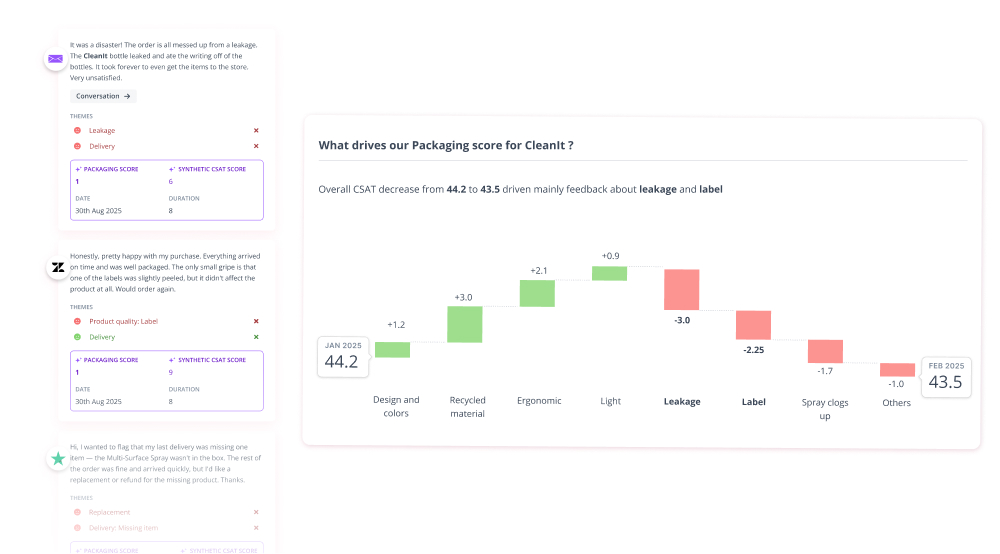
The Scoring Agent creates custom metrics like Synthetic CSAT directly from unstructured feedback, while Impact Analysis shows exactly which themes are driving the score up or down.
You add meaningful KPIs without adding survey questions, which matters when you consider that the typical CX survey samples only 7% of a company's customers, according to Forrester. The Scoring Agent helps you close that gap by extracting metric-grade intelligence from the feedback you already have.
Mitre 10, a New Zealand hardware retailer, used theme-to-metric analysis to put a precise number on a pain point they'd long suspected was important. Thematic revealed that stock availability issues were taking half an NPS point off their overall score. That specific, quantified finding gave their team the evidence needed to reinforce it as a strategic priority.
Jetstar achieved a 25-point NPS increase using Thematic to connect customer feedback to business action across divisions. In the words of Dustin Lewis, Head of Operational Strategy: "With Thematic we've translated customer behaviour to specific business divisions who take action based on the insights."
Why auditability matters as much as the answer
The credibility of your output depends on your ability to show your work. When an executive asks "how do you know pricing is driving NPS down," Thematic lets you click through from the theme to every individual comment that supports it. Statistical significance indicators tell you which findings are robust and which reflect noise.
Smith & Smith, New Zealand's leading vehicle glass repairer, built their insights workflow around exactly this: using Thematic alongside Qualtrics and Power BI to discover themes in customer feedback, tie them to NPS impact, and push those findings to stakeholders across the business.
Because themes mean the same thing whether they come from a survey, support ticket, or in-store interaction, the metric connection reflects the full picture, not just one channel. Automated discovery, metric correlation, and transparent output in one connected system.
This is how Thematic differs from black-box AI tools that surface a number without showing how they got there. The auditability isn't a bonus feature. It's what makes the output usable in practice.
From themes to action
The goal isn't a better report. It's knowing which themes to fix, what impact fixing them will have, and routing that clarity to the teams who can act on it. That's the Customer Intelligence and Activation model Thematic is built around: from surfacing themes, to quantifying their impact, to connecting that intelligence to decisions.
An independent Forrester Total Economic Impact study validated 543% ROI, $652,000 in annual savings, and payback under 6 months for Thematic customers.
Want to see which themes are driving your NPS? Book a demo and we'll show you the connection in your own data.
Share
Link Copied!
Request a demo of Thematic's Customer Intelligence Platform
Thematic turns fragmented feedback into one consistent source of customer truth — so every team acts on the same customer story. Up and running in days, not quarters.
Thank you! Your submission has been received!
Oops! Something went wrong while submitting the form.