Customer Intelligence: The Cross-Functional Approach to Understanding Customers
Cross-functional customer intelligence gives CX, product, operations, and marketing teams decision-ready insights from unified feedback. No more waiting weeks for analyst reports or losing context between departments.
Customer intelligence transforms fragmented feedback into cross-functional insights that CX, product, operations, and marketing teams can all act on.
Cross-functional customer intelligence goes beyond single-team analytics by removing PS dependencies, adding transparency, and making insights accessible to every function.
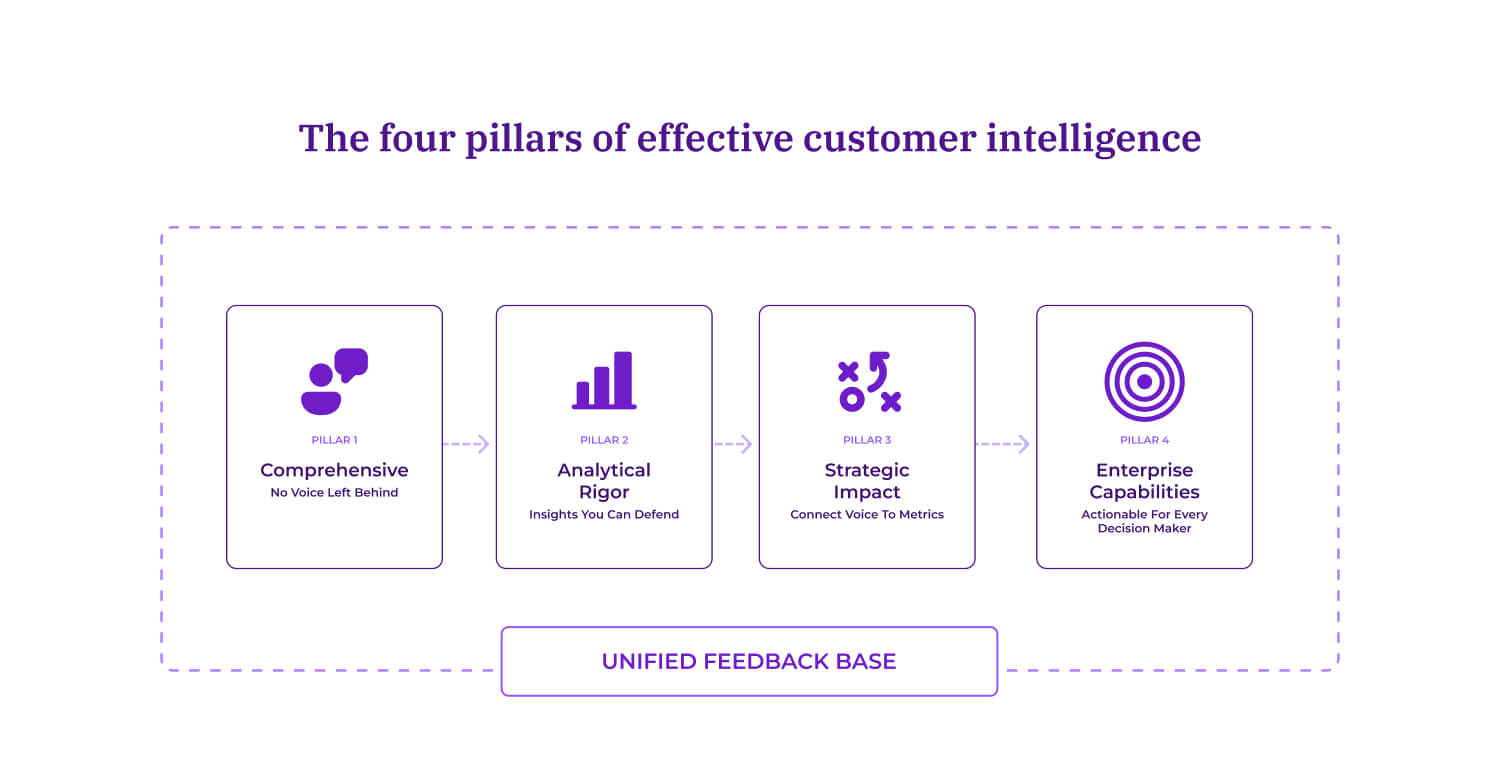
Effective customer intelligence delivers on four pillars: comprehensive coverage, analytical rigor, strategic impact, and enterprise capabilities.
Real results: A large retailer cut analysis time by 92% (7 days to 5 hours) and generated $4.8M in incremental revenue. DoorDash completed nearly 1,000 research projects. Atom Bank reduced calls 69% while growing 110%.
Thematic’s Customer Intelligence and Activation system unifies 100+ feedback sources, discovers themes automatically, quantifies business impact per theme, and gives every team self-serve access with full audit trails.
543% ROI validated by Forrester, with payback under 6 months.
You're collecting valuable feedback across multiple channels. Think survey responses, product reviews, support tickets, chat logs, and social media mentions. Each one contains insights that could inform better decisions.
Your research team works to analyze it, but by the time insights reach product, operations, and marketing teams, the context they need for their specific decisions may be missing.
Meanwhile, there's an opportunity to move faster.
Imagine launching features your customers want before competitors spot the same patterns. Or addressing issues proactively before they escalate.
The difference isn't about collecting more feedback or investing in fancier tools. It's about transforming customer voices into insights that every function can act on quickly.
Thematic’s Customer Intelligence and Activation system makes this transformation possible by unifying customer voices across every channel into decision-ready insights that every team can act on, and connecting those insights to the actions that drive outcomes. It is the foundation for Agentic CX: a system where specialized CX Agents continuously turn unstructured feedback into answers, scores, and actions, guided by governance, definitions, and business context.
What is customer intelligence?
Customer intelligence transforms raw customer feedback into insights that inform decisions across CX, product, operations, and marketing teams.
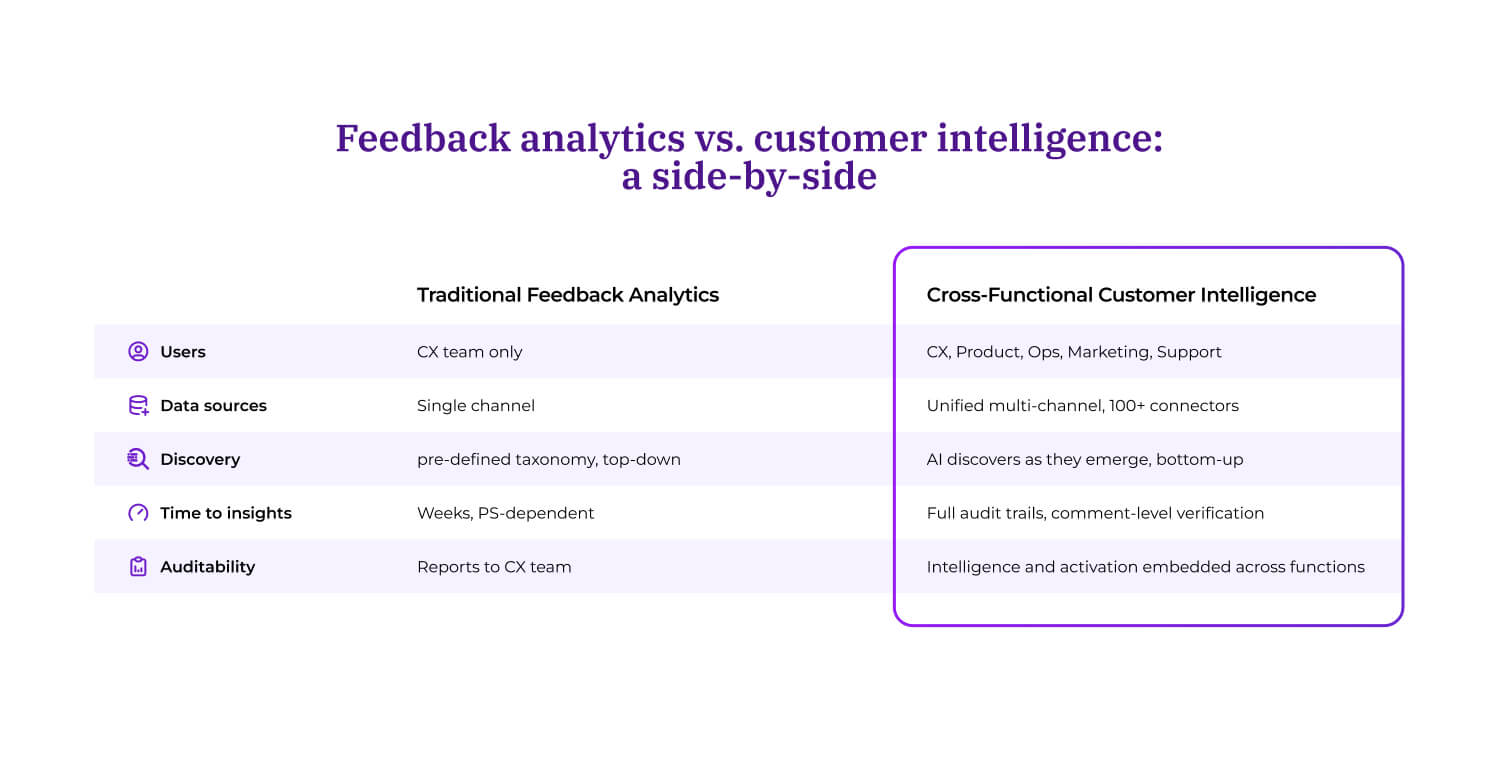
Unlike traditional feedback analytics that only serve your CX team, cross-functional customer intelligence gives each department their own view of unified customer data. This means you act on customer needs faster and prove ROI through results you can measure.
Thematic’s Customer Intelligence delivers this transformation through a team of specialized CX Agents: the Theming Agent organizes feedback into a consistent customer truth, the Answers Agent helps teams ask and answer questions with evidence, the Scoring Agent turns language into decision-grade outcome metrics, and the Actions Agent routes prioritized actions to the right teams.
Here's why this matters: your customers don't experience your business by department.
They experience it as one continuous journey. When a customer complains about a confusing checkout, that's simultaneously a product issue (UX design), an operations issue (training needs), and a marketing issue (communication gap).
Traditional analytics force you to analyze the same feedback three separate ways. Cross-functional customer intelligence analyzes it once, then delivers targeted views so each team knows exactly what to fix.
According to a McKinsey analysis, only 15% of CX leaders are satisfied with how their company measures customer experience. Why? Because typical survey systems only capture 7% of your customer base, creating blind spots for decision makers.
Traditional feedback analytics serves a single team with top-down taxonomies. Cross-functional customer intelligence serves every function with bottom-up AI discovery and full audit trails.
With Thematic, your teams make customer-driven decisions in hours, not weeks, with full confidence that their insights are transparent, defensible, and grounded in actual customer voices.
Why enterprises are rethinking their CX analytics stack
Many organizations have invested significantly in feedback technology: licensing platforms from major vendors, building VoC programs, and hiring skilled analysts. These platforms are strong at what they were built for: Qualtrics excels at surveys, Medallia at contact centers and conversations.
But as feedback volume grows and more teams need access, enterprises are finding that monolithic platforms sacrifice analytics depth and activation for breadth. It contributes to what Forrester describes as a cycle of measurement without meaning
The gap between investment and impact often stems from systems designed around different organizational needs than what teams require today.
Dimension
All-in-One Platform Analytics
Cross-Functional Customer Intelligence
Users
CX team only
CX, Product, Ops, Marketing, Support
Data sources
Single channel
Unified multi-channel (100+ connectors)
Discovery
Pre-defined taxonomy (top-down)
AI discovers as they emerge (bottom-up)
Time to insight
Weeks (PS-dependent)
Hours (self-serve)
Auditability
Black-box or limited
Full audit trails, comment-level verification
Impact
Reports to CX team
Intelligence and activation embedded across functions
The single-function bottleneck
Traditional feedback platforms were designed with VoC as a CX team responsibility. Analysts generate reports, and other teams request insights as needed.
This centralized model works well for many organizations. However, as feedback volume grows and business questions become more complex. Some teams find they need more direct access to explore what specific segments are saying, drill into regional patterns, or verify if campaign messaging aligns with actual customer language.
One large grocery retailer in APAC discovered their analysis process took 7 days despite having both an internal PS team and vendor support. The time required wasn't about technical capability but the delivery model: each new question, dataset expansion, or metric refinement required PS engagement.
When they adopted Thematic’s self-serve Customer Intelligence and Activation system, similar analysis took 5 hours.
The customization tax
The alternative many enterprises are adopting is a best-of-breed approach: using purpose-built tools for each part of the CX tech stack and connecting them together.
A modern best-of-breed CX stack typically combines six layers: a data warehouse (like Snowflake), a survey platform (like Qualtrics CoreXM), a customer intelligence layer (like Thematic), a BI tool (like Power BI or Tableau), digital experience analytics, and journey orchestration.
Most enterprises already own three or four of these components. The piece that unlocks the most value is usually the customer intelligence layer, which turns unstructured feedback into structured, decision-ready intelligence and pushes it back into the tools teams already use.
Medallia uses a hybrid approach combining rules-based topics, supervised machine learning, pre-built AI models, and ML-based theme discovery.
Qualtrics offers both XM Discover (supervised ML requiring labeled training data) and TextIQ (clustering-based analysis).
These technologies are sophisticated and capable. The consideration for many teams is the practical experience of deploying them.
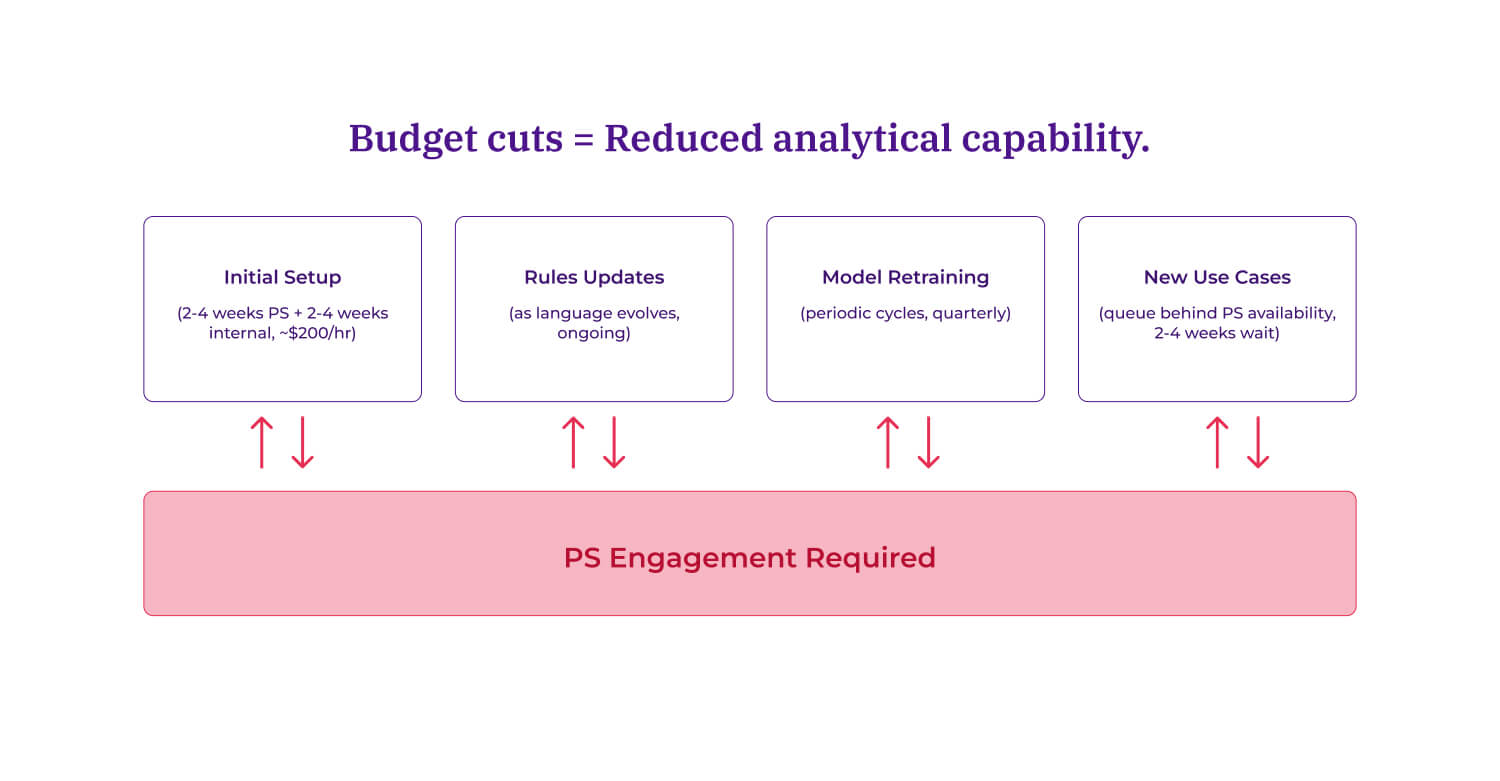
Setup typically requires 2 to 4 weeks of professional services at approximately $200 per hour, plus another 2 to 4 weeks of internal team work. That's the initial implementation.
Every layer in a hybrid analytics system needs ongoing professional services. When budgets tighten, analytical capability shrinks with them.
Each layer in a hybrid system (rules, supervised models, pre-built models) needs ongoing maintenance.
Rules require manual updates as customer language evolves.
Supervised models need periodic retraining with newly labeled data.
Pre-built industry models may need adjustment to fit your specific business context.
Michael Sherwood, Head of Brand & Experience at Atom Bank, described the difference after consolidating seven feedback channels in Thematic: "Thematic lets us quickly turn unstructured feedback from across channels into clear insights that directly inform our product roadmap and corporate strategy.”
The bank reduced calls related to unaccepted mortgage requests by 69% and device issues by 40%, while growing their customer base 110% year over year.
The PS cost trap
Professional services engagement creates a consideration for teams managing variable budgets: when PS budgets are reduced, analytical capability can be affected.
New use cases may take longer to launch. Urgent questions might need reprioritization. Account manager transitions can require rebuilding institutional knowledge about how your taxonomy was built.
Lee King, Head of Insights at LendingTree, evaluated multiple platforms before selecting Thematic. He was immediately hooked after the analysis worked straight out of the box. No training, no setup, immediate value.
LendingTree now processes over 20,000 comments every 90 days, saves hundreds of hours in data preparation and analysis, and delivers insights that product teams and lending partners access directly without waiting for analyst interpretation.
The transparency problem
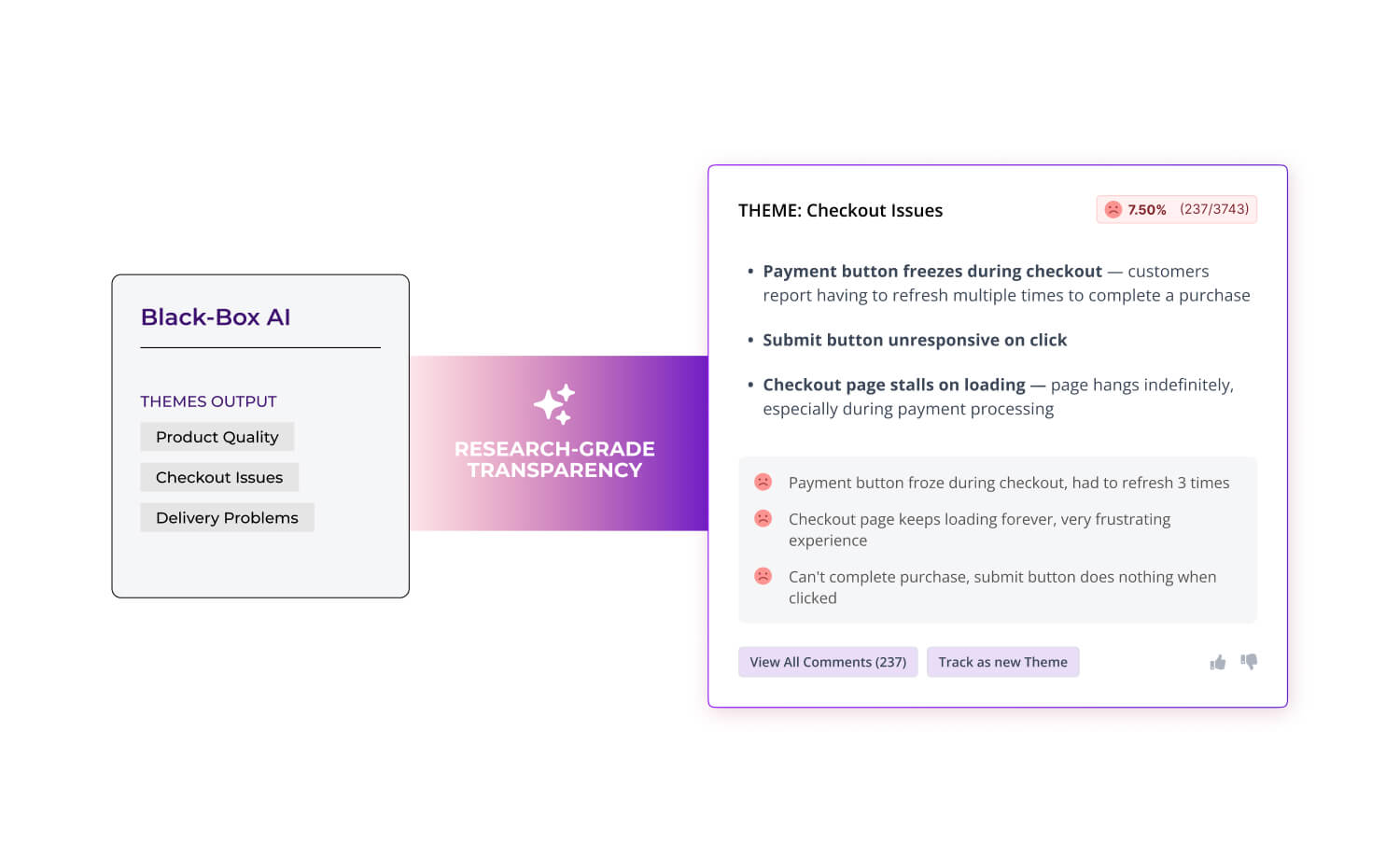
Some AI-powered tools operate as black boxes. They surface themes but can't explain how those themes were constructed or why specific comments were grouped together.
This makes it challenging to validate results or explain findings to stakeholders who need to understand the methodology. When executives ask whether a specific theme really impacts NPS, you need the ability to drill down to comment-level evidence to demonstrate the connection.
Customer intelligence platforms like Thematic, built with research-grade transparency solve this by providing full audit trails, comment-level verification, and visibility into exactly how AI constructed each theme.
Black-box tools surface themes but can't explain them. Research-grade transparency lets you trace every insight back to the customer comments that created it.
You can validate, refine, and customize without losing the efficiency of automated discovery.
The four pillars of effective customer intelligence
Your customer intelligence succeeds when it delivers four interconnected capabilities: comprehensive coverage, analytical rigor, strategic impact, and enterprise capabilities.
Effective customer intelligence requires all four pillars working together. Remove one and the system produces reports instead of decisions.
Each pillar reinforces the others to transform feedback from a reporting exercise into something that actually drives decisions.
Comprehensive customer intelligence: No voice left behind
Effective customer intelligence starts with completeness.
You need feedback from every channel (surveys, reviews, support tickets, chat logs, social media), every product line, every region, and every customer segment flowing into one unified system.
The alternative is insight blind spots. When your marketing team analyzes survey data while product analyzes app reviews and support analyzes tickets, no one sees the complete pattern.
A feature complaint surfaces in support tickets but doesn't make it into the product roadmap because teams aren't working from shared intelligence.
Thematic's native connectors integrate 100+ data sources automatically. It's an analytical necessity while providing convenience.
When Atom Bank unified seven channels in Thematic, they eliminated duplicate analysis efforts, removed data silos, and built a central system to prioritize CX improvements. The sophistication of Thematic's theme discovery delivered insights for their CX team to advise the C-suite, operations, support, and product teams on where to differentiate experiences.
But volume alone isn't intelligence. You also need to surface what's emerging, not just what's loud.
Thematic's Emerging Themes Detection automatically identifies issues mentioned by as few as 0.5% of your customers but showing rapid growth. By the time a problem reaches 5% mention rate in traditional dashboards, you've already lost customers and revenue.
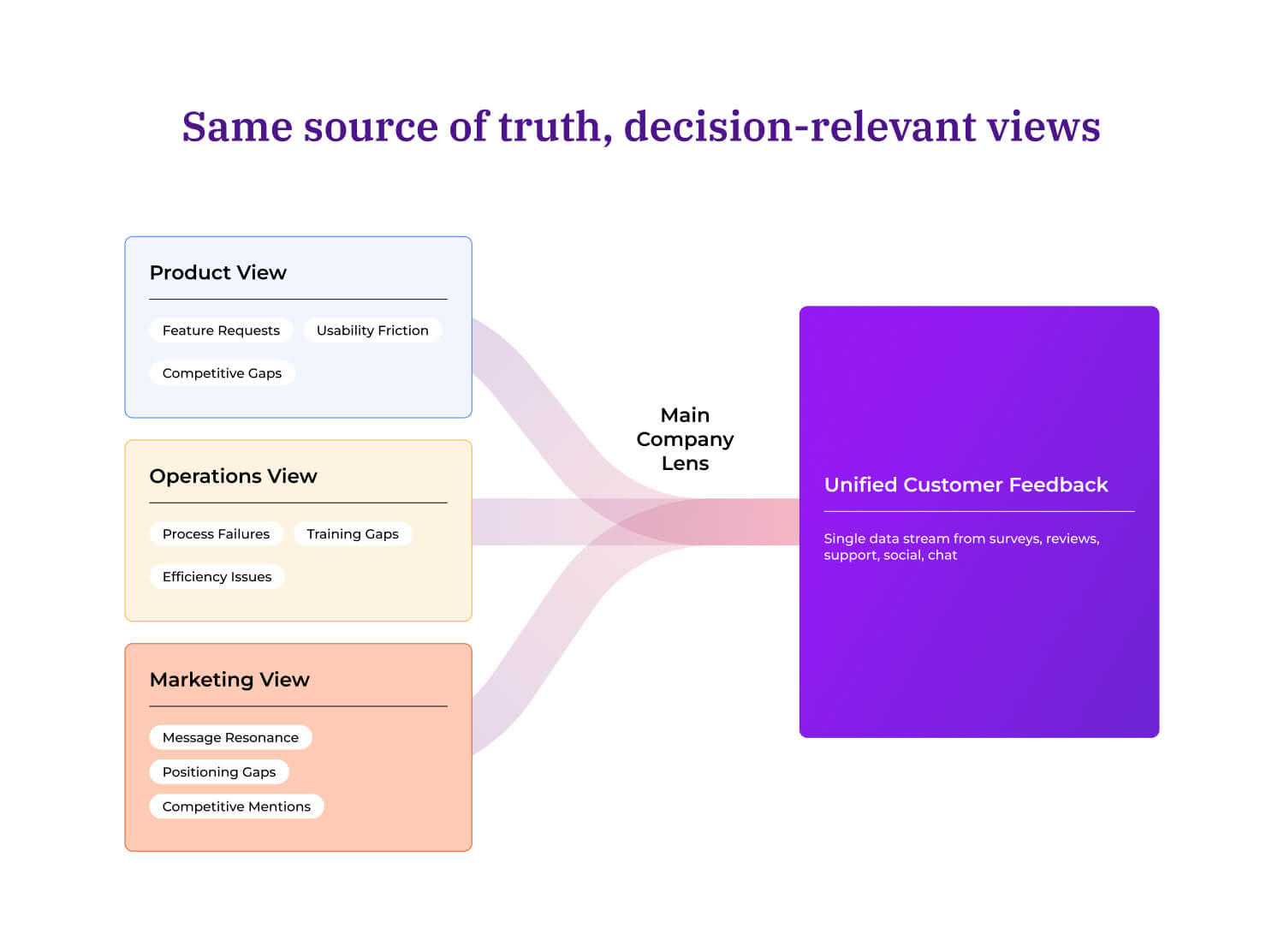
Thematic’s Lenses take this further. A main company Lens unifies feedback from every channel into one comprehensive set of themes, your shared customer truth. Each team then gets a tailored Lens shaped to the decisions they own, all drawing from the same trusted source. The Theme Model Editor lets analysts refine and customize themes within each Lens without duplicating data or analysis.
Thematic's Lenses give every team a decision-ready view shaped to their responsibilities, all drawing from the same unified customer truth.
Your product teams can focus on feature requests and usability friction. Your operations team can isolate process failures and training gaps. Your marketing team can track message resonance and competitive mentions.
Everyone works from the same source of truth, but sees insights relevant to their decisions.
Analytical rigor you can defend
Here's the thing about speed: it needs to come with confidence.
When you can't verify insights, it's harder to confidently prioritize what to build next or explain your decisions to stakeholders.
Research-grade customer intelligence means three things: you can see exactly how AI constructed each theme, drill down to every comment contributing to a finding, and validate that patterns are statistically significant, not noise.
Your analysts can see the entire analytical process through Thematic's no-code Theme Model Editor.
You see which comments AI clustered together, what language patterns it identified, and why.
You can refine themes by adding examples, excluding irrelevant mentions, and ensuring each theme represents a distinct customer issue.
Thematic's proprietary AI learns from your refinements, but you stay in control.
This transparency proved critical for the large grocery retailer using Thematic's Customer Intelligence and Activation system to analyze 30+ datasets across 160+ users processing 4M+ comments.
When executives questioned whether a specific theme really drove their $4.8M incremental income, analysts could show the exact comment-level evidence, sentiment distribution, and statistical correlation with business metrics.
Full audit trails and data governance controls ensure compliance and accountability. Statistical significance indicators prevent you from overreacting to noise. Thematic automatically flags when a theme's volume or sentiment shift is statistically meaningful versus random variation.
Strategic impact intelligence: Connect voice to business metrics
Understanding what customers say is valuable. But the real transformation happens when you can show what it means for your business, particularly your revenue, retention, churn, and growth.
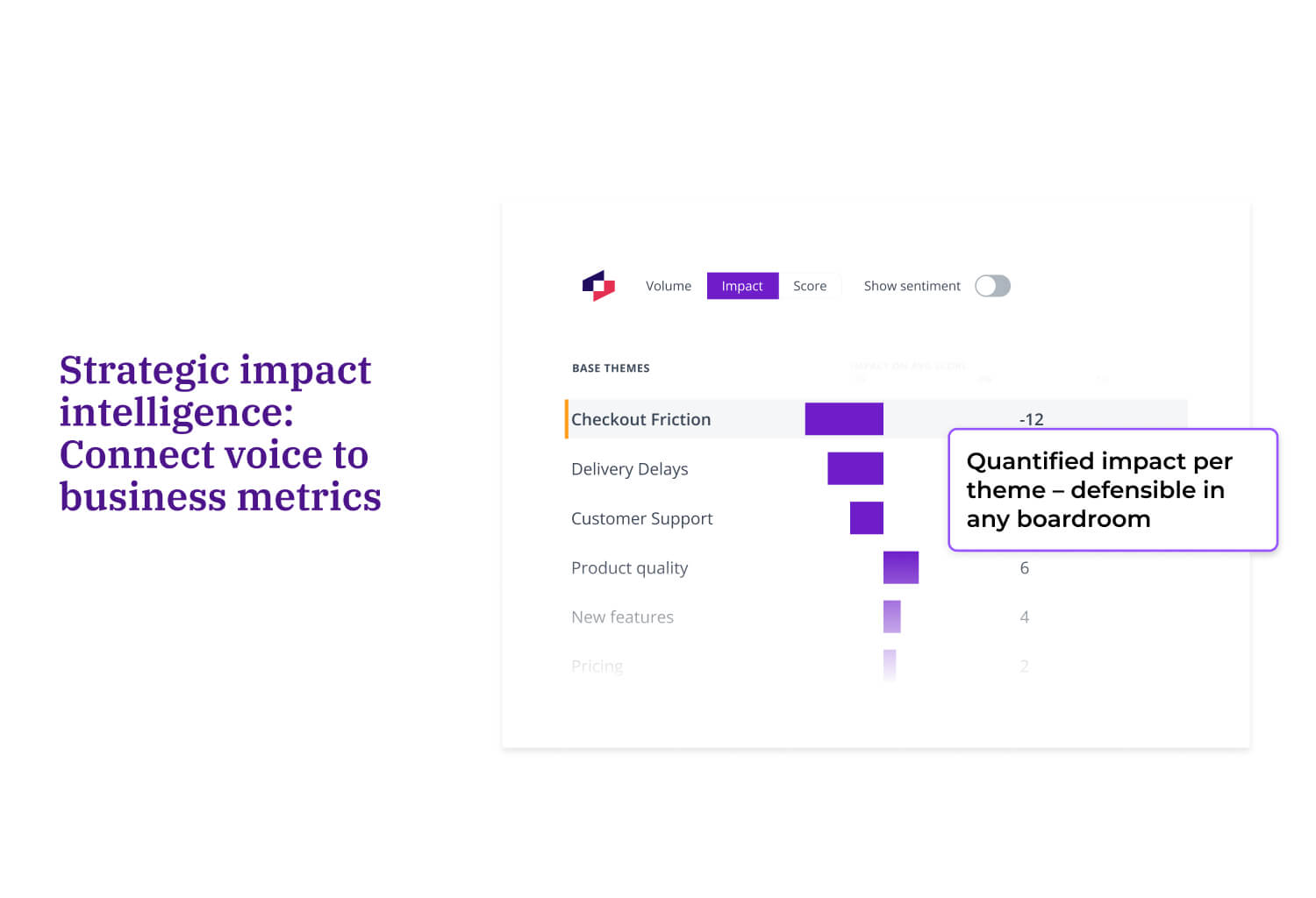
Strategic impact intelligence quantifies exactly how each theme affects business outcomes. Instead of reporting "35% of customers mention pricing," you show "pricing concerns reduce NPS by 8 points among enterprise customers, representing $2.3M annual revenue risk based on our churn correlation analysis."
Impact analysis quantifies how much each theme moves your key metrics, turning qualitative feedback into defensible prioritization for leadership.
Thematic's impact analysis does this automatically by correlating theme mentions with your key metrics (NPS, CSAT, retention rate, revenue per customer). For every theme, you see precise quantified impact: how many points it moves your metric, which direction, and across which segments.
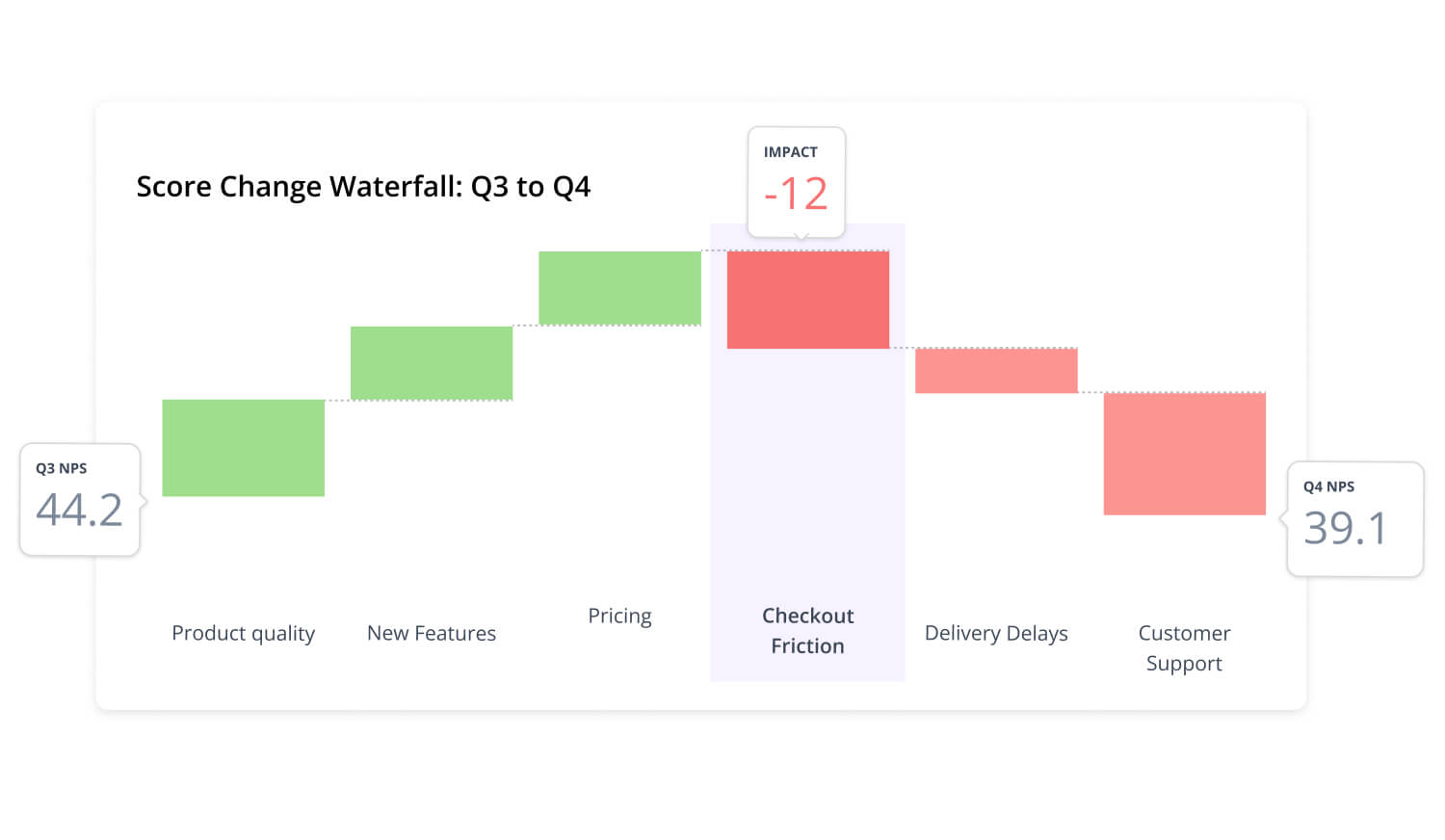
The Score Change analysis takes this further by explaining exactly why your metrics moved period over period. Did NPS drop 3 points last quarter?
The waterfall shows you that shipping delays cost 5 points, but improved support interactions gained 2 points, for a net decline of 3. Every movement reconciles mathematically.
The Score Change Waterfall reconciles every point of metric movement, showing exactly which themes drove gains and which drove losses between periods
Custom Scores extend this capability by letting you create plain-language metrics from feedback text. Thematic’s Scoring Agent uses AI to generate these custom metrics tailored to specific business outcomes, linking scores to the themes driving them so teams can see exactly why a metric changed. You can also layer business context (like revenue, customer tenure, region) into feedback to surface segment-specific insights that matter to each team.
Instead of relying solely on numerical survey ratings, the Scoring Agent can measure "perceived trust," "churn risk signals," or "upsell readiness" by identifying the specific language patterns that predict these outcomes. This means fewer scale questions, shorter surveys, better response rates, and KPIs that actually reflect your business priorities.
Enterprise capabilities: Actionable insights for every decision maker
The most sophisticated analysis doesn't reach its potential if only a few people can access it. Your customer intelligence needs to democratize insights while maintaining analytical standards and governance.
Thematic Answers solves this with a natural language query interface grounded in actual customer feedback.
A product manager types "Why are enterprise customers churning?" and gets an AI-generated summary citing specific themes, quantified impact, and direct customer quotes. Every claim links back to real comments in your dataset, so you can verify exactly what the AI concluded.
This enabled DoorDash to shift from "research" to "WeSearch." Instead of the research team being a bottleneck, company-wide employees accessed audience insights directly through Thematic. The research team focused on complex strategic questions while routine inquiries got instant answers.
Custom Summaries and automated workflows extend this capability. You can set up alerts when specific themes exceed thresholds. Insights flow automatically to responsible teams via Slack, email, or your existing workflow tools.
For enterprises managing data privacy and compliance, this matters enormously. Role-based access controls ensure sensitive feedback only reaches authorized viewers. Data sovereignty options keep information in required jurisdictions.
Thematic goes beyond analysis to activation through its Actions Agent. For each piece of feedback, Predictive Actions determines the best next step and routes it to the right team: scoring customers at risk of churn for the retention team, creating tickets for recurring issues, surfacing upsell opportunities for sales, and automating compliance reporting.
This supports both inner loop work (making it right for individual customers) and outer loop work (fixing root causes so issues stop recurring). The result: insights don’t just get reported, they get routed, prioritized, and operationalized.
For enterprises managing a best-of-breed CX tech stack, Thematic works alongside your existing collection and operational tools as the dedicated analytics layer, turning signals from any source into tracked, measurable outcomes. Your data warehouse becomes an intelligence layer. Your survey platform becomes one input among many. Your BI dashboards start reflecting what customers are actually experiencing.
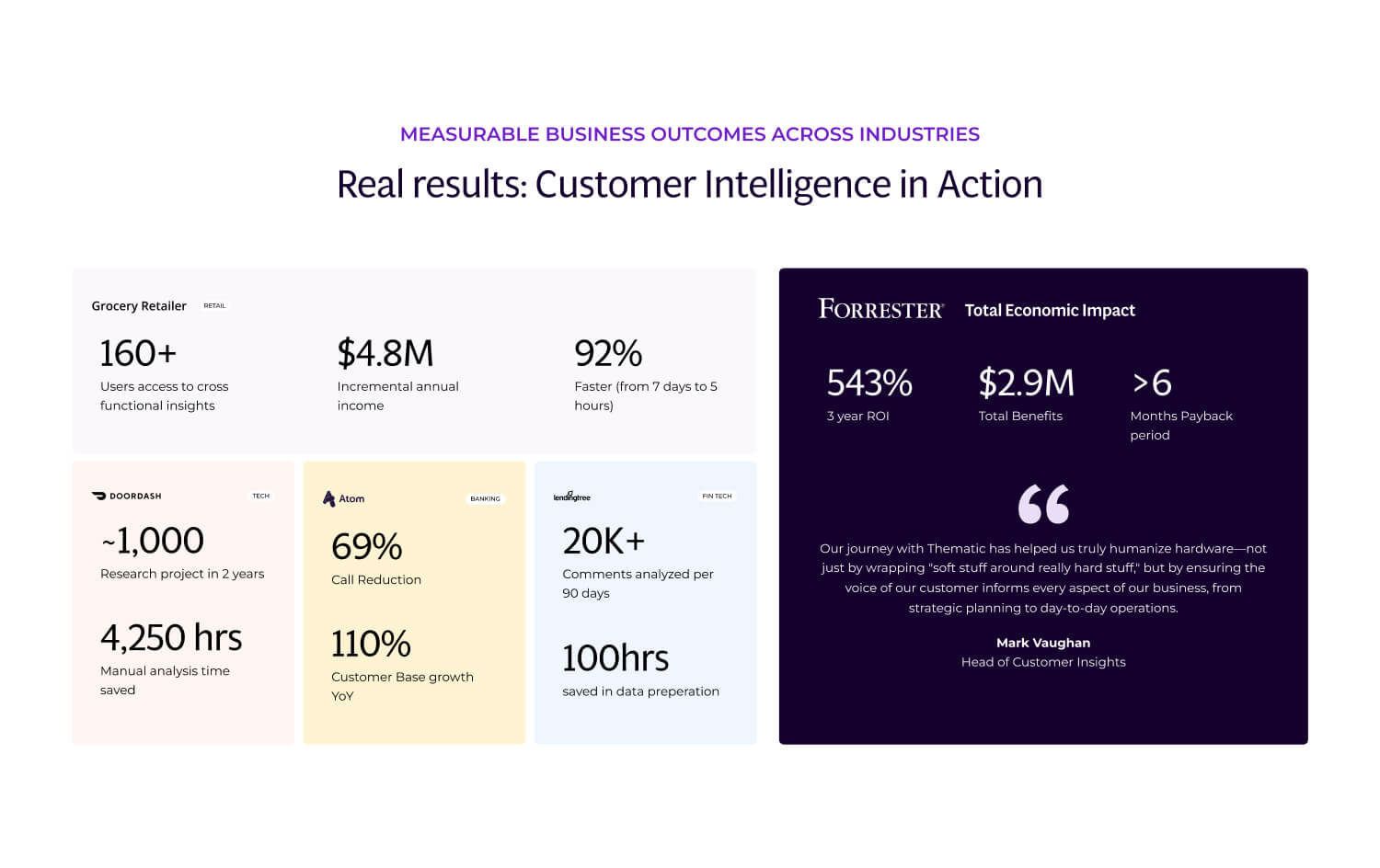
The difference between concept and reality shows clearest in measurable business outcomes.
These enterprises transformed customer feedback from a reporting exercise into something that actually drives decisions:
Enterprise results from Thematic's Customer Intelligence span retail, tech, banking, and fintech, with Forrester validating 543% ROI and payback under six months.
Large grocery retailer: 92% faster insights, $4.8M impact
A major APAC grocery retailer augmented their Medallia deployment with Thematic to address a critical velocity problem. Despite having both an internal professional services team and Medallia vendor support, reaching insights took 7 days.
With Thematic, the same analysis took 5 hours: a 92% reduction in time to insight.
Key results:
$4.8M in incremental annual income from customer-driven initiatives (4.75% of total store sales)
Systematically tracked which themes drove which initiatives and measured resulting revenue impact
Their Listening Engagement Manager summarized it: "[Thematic] has been the ultimate unlock for us."
DoorDash: Democratizing research across nearly 1,000 projects
DoorDash transformed their research function from bottleneck to enabler through company-wide access to Thematic’s Customer Intelligence and Activation system. Operating a complex four-sided marketplace, they gave company-wide employees direct access to audience insights.
Key results:
Nearly 1,000 research projects completed over two years
4,250 researcher hours saved
Highest employee satisfaction scores and best retention in entire design organization
"The time savings Thematic provides is essentially infinity." Zach Schendel, Head of Research
Atom Bank: 69% call reduction, 110% growth
Atom Bank unified seven feedback channels in Thematic to build a complete view of customer experience across three product lines: Mortgage, Savings, Deposits.
Key results:
69% reduction in calls related to unaccepted mortgage requests
40% reduction in calls about device issues
43% reduction in savings-related calls
110% year-over-year customer growth
"Thematic lets us quickly turn unstructured feedback from across channels into clear insights that directly inform our product roadmap and corporate strategy." Michael Sherwood, Head of Brand & Experience
LendingTree: Customer-led transformation at scale
LendingTree processes over 20,000 comments every 90 days across 10 data sources spanning 7 product verticals. After evaluating multiple platforms, Lee King, Head of Insights, selected Thematic because "Thematic works straight out of the box."
Key results:
Hundreds of hours saved in data preparation and analysis
Shift from product-led to customer-led decisions
Product teams and lending partners access NPS drivers directly without waiting for analyst interpretation
10 data sources across 7 product verticals
The Forrester Total Economic Impact study quantified what these customer stories demonstrate: Thematic's Customer Intelligence and Activation system delivers measurable financial returns.
Key results:
543% ROI over three years
$2.9M total benefits
$652K annual savings from automating 4,250 hours of manual analysis work
Payback in under 6 months
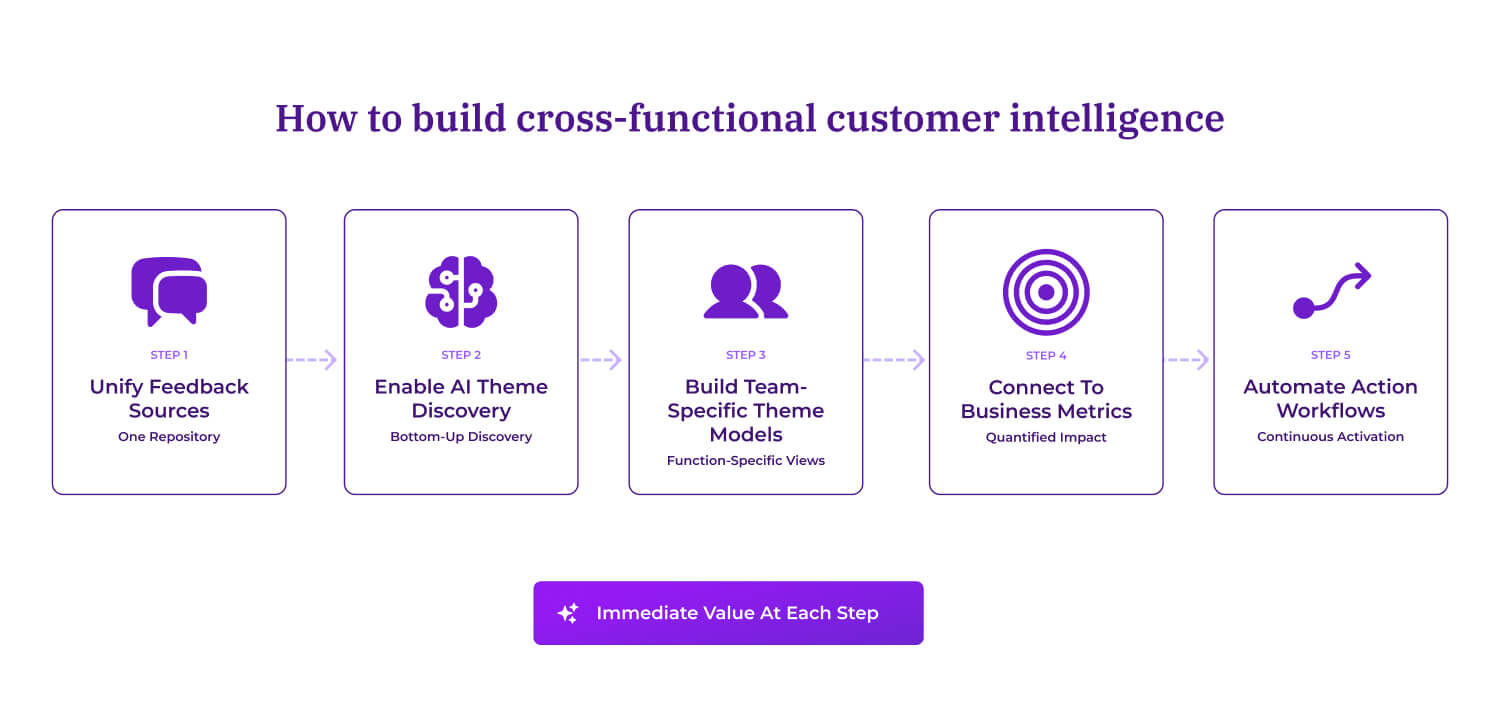
How to build cross-functional customer intelligence
Building effective customer intelligence requires five systematic steps.
Each step delivers immediate value while building toward a continuous intelligence loop that sharpens with every cycle.
Each builds on the previous to create an intelligence system that evolves with your business.
Step 1: Unify feedback sources into a single system
Start by bringing every feedback channel into a single platform. This means survey responses, product reviews, support tickets, chat logs, social media mentions, and any other source where customers share their experience.
Thematic's 100+ native connectors handle most sources automatically. Unification immediately reveals patterns that were invisible when feedback lived in separate systems. Set clear data governance from the start: who has access to what feedback, how you handle sensitive information, and what's your data retention policy.
Step 2: Enable AI-powered theme discovery
Once feedback is unified, the next challenge is making sense of it. You could manually code every comment, but that doesn't scale beyond a few thousand responses and introduces analyst bias about what matters.
AI-powered theme discovery solves this by automatically identifying patterns in customer language without requiring pre-defined categories. Thematic's unsupervised approach discovers themes as they emerge from data itself, then lets human analysts refine and validate those themes.
This bottom-up discovery is fundamentally different from top-down taxonomy approaches. Instead of forcing customer feedback into predetermined buckets, unsupervised AI surfaces what customers actually talk about, including problems you didn't know existed.
Step 3: Create team-specific Lenses
With themes discovered and quantified, the next step is delivering relevant insights to each function. This is where Lenses enable each team to get a tailored, decision-ready view from the same unified customer truth.
Your product teams need to see feature requests, usability friction, and competitive gaps. Your operations teams need process failures, training gaps, and efficiency opportunities. Your marketing teams need message resonance, positioning gaps, and content effectiveness. Each team gets their own Lens without duplicating data or analysis, and the Theme Model Editor lets analysts refine themes within each Lens to match their specific business context.
Step 4: Connect insights to business metrics
Understanding what customers say is valuable. But the real transformation happens when you connect themes to metrics that drive business decisions: NPS, CSAT, retention rate, revenue per customer, support costs, conversion rate.
Start with Impact Analysis by correlating every theme with your key metrics. Thematic does this automatically using statistical methods to identify which themes have the strongest relationships with metric movements. This quantification changes conversations from "is this important?" to "what's our implementation timeline?"
Create Custom Scores using Thematic’s Scoring Agent for concepts your existing metrics don’t capture. If churn risk is critical but you only measure it through actual churn (a lagging indicator), build a Custom Score that identifies leading language indicators in feedback.
Step 5: Activate with the Actions Agent
The final step is moving from insights to activation at scale. Thematic’s Actions Agent makes this operational through three capabilities now in early access: Predictive Actions recommends the best next step for each piece of feedback based on your organization’s playbooks and workflows. Anomaly Detection surfaces spikes and emerging issues before they escalate. Comment Routing triages feedback to the right teams automatically. If "payment failure" mentions spike above 2%, your payments team gets notified via Slack. A customer signaling churn risk gets routed to retention. These compress response time from days to minutes.
Predictive Actions supports both inner loop (making it right for individual customers) and outer loop (fixing root causes) work. Actions can be assigned, tracked, and pushed into downstream tools like Jira, Zendesk, Slack, or email. Set up recurring summaries for regular decision-making cycles: weekly executive summaries, monthly product council reports, quarterly board materials.
Leading enterprises are already using these Agentic CX capabilities to score churn risk with the Scoring Agent, route next-best actions with the Actions Agent, and automate compliance reporting: turning customer intelligence into operational outcomes. This is how CX teams shift from reporting to orchestrating impact.
Choosing a customer intelligence and activation platform
Not all customer intelligence platforms deliver the same outcomes. The four pillars above (comprehensive coverage, analytical rigor, strategic impact, and enterprise capabilities) are your evaluation framework. Here’s how leading approaches compare in practice:
Dimension
Medallia
Qualtrics
Thematic
Discovery method
Hybrid: rules + supervised ML + pre-built models + ML discovery
XM Discover: supervised ML. TextIQ: word co-occurrence
Unsupervised AI: themes surface from data, no pre-labeling
Setup time
2-4 weeks PS (~$200/hr) + 2-4 weeks internal
2-4 weeks PS + 2-4 weeks internal
~3 days for full theme model
PS dependency
Heavy: customization and new use cases require PS
Heavy: model training and taxonomy changes require PS
Self-serve with minimal CS involvement
Maintenance
Multiple layers (rules, ML models, pre-built models)
Retraining cycles, taxonomy upkeep
Auto-enriched as new data arrives
Starting point
Top-down: pre-defined taxonomy
Top-down: analyst-defined categories
Bottom-up: discovers themes as they emerge
Auditability
Limited traceability across complex layers
Black-box ML / clusters need interpretation
Full audit trails, comment-level verification
Architecture
Monolithic (end-to-end suite)
Monolithic (end-to-end suite)
Best-of-breed Customer Intelligence and Activation layer (works alongside existing tools)
The practical differences matter more than technical architecture. Medallia and Qualtrics have sophisticated capabilities, but deploying them requires ongoing PS engagement. This creates friction regardless of underlying technology. Setup takes weeks. New use cases queue behind PS availability. Budget cuts affect analytical capability immediately.
Thematic’s Customer Intelligence eliminates this friction through self-serve analysis. Your teams explore feedback directly, build new theme models for emerging questions, and expand data sources without requiring vendor or consultant support. It also maintains research-grade rigor while enabling operational speed.
Moving forward: From feedback chaos to confident decisions
You don’t need to implement everything simultaneously. Start with consolidating your most important feedback sources. Enable theme discovery on that unified data with Thematic. Quantify which themes impact your key metrics. Create tailored Lenses for your highest-impact functions. Activate with the Actions Agent for critical issues.
Each step delivers immediate value while building foundation for the next. Together, these steps form Thematic's Intelligence Loop: continuous theme discovery feeds decisions and activation, which builds institutional memory that makes the next cycle sharper.
Thematic delivers this foundation: Lenses unify feedback into a shared customer truth with tailored views for every team, the Scoring Agent turns language into metrics teams can act on, and the Actions Agent routes prioritized actions to close the loop at scale. Together, they lay the groundwork for Agentic CX: where insights don’t just get reported, they get operationalized. In minutes, not weeks.
Ready to transform how your organization uses customer feedback? Book a demo to see how Thematic delivers cross-functional insights at enterprise scale.
Frequently asked questions about customer intelligence
What is customer intelligence and why does it matter for enterprises?
Customer intelligence transforms raw feedback into insights that inform decisions across CX, product, operations, and marketing teams. Unlike traditional analytics serving a single function, it provides each team with decision-relevant views on unified customer data, enabling faster action and measurable ROI.
When a customer complains about checkout, cross-functional intelligence delivers targeted insights so product, operations, and marketing teams each know exactly what to fix.
What's the best way to analyze open-ended customer feedback at scale?
AI-powered unsupervised theme discovery automatically identifies patterns in customer language without pre-defined categories. Thematic analyzes feedback to discover themes as they emerge, then lets analysts refine and validate for accuracy.
This bottom-up approach surfaces unexpected problems while maintaining research-grade rigor through transparent methodology and comment-level verification.
Do I need a separate analytics tool if I already have Medallia or Qualtrics?
Many enterprises are adopting a best-of-breed approach: keeping their existing platform for feedback collection while adding Thematic as a dedicated intelligence and activation layer. Over half of Thematic customers also use Qualtrics or Medallia for surveys.
The decision depends on whether your current platform delivers the velocity, accessibility, and transparency your teams need.
How do I unify customer feedback across channels into a single source of truth?
Use a platform with native connectors for your feedback sources (Thematic integrates 100+ automatically) or APIs for custom systems. Thematic’s Lenses then let you create a main company Lens as your shared customer truth, plus tailored Lenses for each team’s decisions. The outcome: one searchable repository where any team can explore feedback through their own decision-ready view without needing to know which system captured it.
Set data governance rules upfront (access controls, retention policies, sensitive data handling) as these become harder to change later.
What teams beyond CX should have access to customer intelligence?
Product, operations, marketing, support, sales, and executive leadership all benefit from customer insights access. The key is giving each function their own view on unified data: same source of truth, different decision-relevant views.
DoorDash's shift to "WeSearch" gave company-wide employees access to insights, enabling nearly 1,000 research projects over two years.
How can customer feedback analytics help reduce churn?
Customer intelligence reduces churn through early warning signals and root cause identification. Use Thematic’s Scoring Agent to build Custom Scores that identify leading language indicators of churn risk, then use Impact Analysis to show which specific themes drive churn across your base. The Actions Agent can then route at-risk customers to your retention team automatically.
Atom Bank reduced calls (a leading churn indicator) by 69% for mortgages and 40% for device issues by systematically addressing themes quantified as high-impact.
What’s the ROI of investing in a customer intelligence and activation platform?
The Forrester Total Economic Impact study found 543% ROI over three years with payback under 6 months. Benefits included $652K annual savings from automating 4,250 hours of analysis work, plus faster decision making and revenue growth from launching features customers wanted.
One large grocery retailer generated $4.8M in incremental annual income (4.75% of store sales) from feedback-driven initiatives.
How is customer intelligence different from voice of customer (VoC)?
Customer intelligence is broader than traditional VoC programs in three ways: it serves every function (not just CX) with decision-relevant Lenses on unified feedback, connects feedback to business metrics automatically through the Scoring Agent, and goes beyond reporting to activation through the Actions Agent, which routes prioritized actions to the right teams.
Traditional VoC produces periodic reports for CX teams; customer intelligence delivers continuous decision fuel to everyone who needs it.
Share
Link Copied!
Request a demo of Thematic's Customer Intelligence Platform
Thematic turns fragmented feedback into one consistent source of customer truth — so every team acts on the same customer story. Up and running in days, not quarters.
Thank you! Your submission has been received!
Oops! Something went wrong while submitting the form.