Enterprises are deploying AI chatbots and agents faster than they can tell whether customers like them. Adoption of AI agents in customer service jumped from 39% in 2025 to 66% in 2026, a 1.7x rise in a single year, according to Salesforce. Gartner reports that 91% of customer service and support leaders are under pressure to implement AI in 2026. Yet the dashboards those leaders watch measure whether the bot ended the conversation, not whether the customer walked away satisfied. Containment rate, deflection rate, and a blended CSAT score all reward a closed chat.
To analyze what customers are actually saying about your AI chatbot, gather the open-text feedback where they describe it. That means post-chat survey comments, app store reviews, support tickets, escalation notes, and NPS or CSAT verbatims. Then run that text through a feedback analytics platform like Thematic. Thematic groups the unstructured comments into themes and sentiment, and traces every theme back to the raw feedback behind it. This is a different job from bot operations metrics. Deflection tells you how often the bot avoided a handoff. Thematic tells you why customers said "it didn't understand me," and how many of them said it.
Below: what counts as feedback about your chatbot, why operational metrics miss it, what good analysis requires, and how Thematic does it, plus the buyer questions to ask first.
What "feedback about your AI chatbot" actually means
Feedback about your AI chatbot is the unstructured, open-text commentary customers leave about their experience with the bot, as opposed to the numeric performance metrics the bot generates on its own.
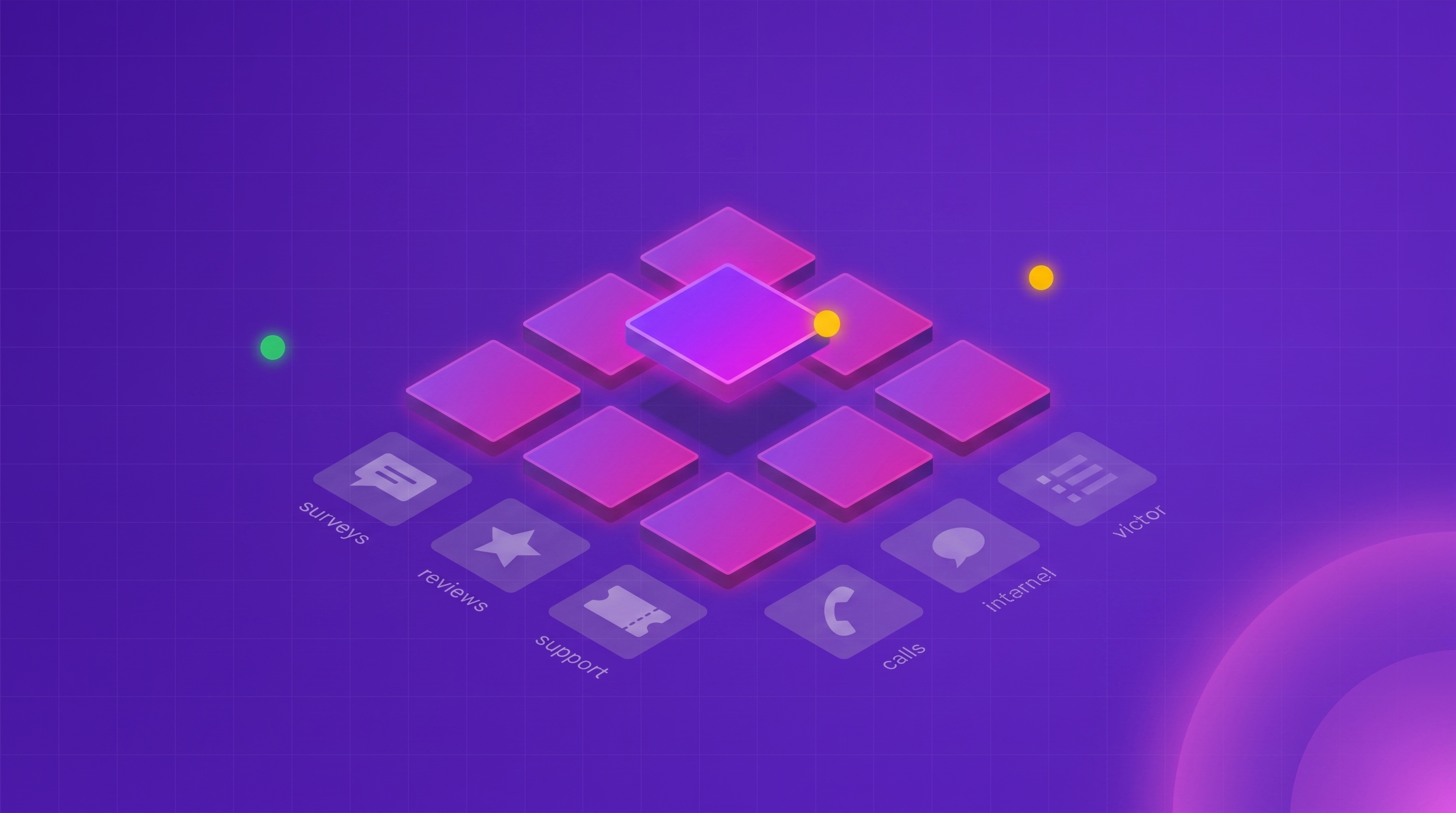
It shows up across channels that most teams already collect:
- Post-chat survey comments, where a customer explains a rating they just gave the bot.
- App store and review-site text, where the bot is named as a reason for a one-star or five-star review.
- Support tickets and escalation notes, especially the ones that start with "the bot couldn't help me."
- NPS and CSAT verbatims, where the chatbot experience surfaces inside a broader survey.
- Social posts and community threads, where customers vent or praise in public.
This is easy to confuse with bot operations metrics. Containment rate, resolution rate, and CSAT-on-bot are counts and scores that tell you what happened. The open-text feedback tells you what customers thought about it, in their own words. Only the second answers "what are customers saying about our chatbot," and only the second tells you what to fix.
Why chatbot dashboards miss what customers are saying
Operational metrics are structurally blind to customer sentiment because they reward the bot for ending conversations, not for solving problems. A chatbot can "contain" a chat by giving a generic answer that stops the customer from escalating, even when the underlying issue is unsolved. Containment rate goes up. The customer leaves unhappy. As the CX vendor Ada puts it, containment rewards not-escalating rather than resolving.
The word "resolution" hides three very different outcomes, a distinction the CX company Lorikeet draws clearly:
- Genuine resolution. The customer's problem is solved.
- Deflection. The ticket is closed, but the problem is not solved.
- Frustrated abandonment. The customer sees the bot as a barrier and gives up.
A blended CSAT score hides the same problem from a different angle. AI handles the easy, high-satisfaction inquiries, so a single averaged score can look healthy while the hard cases quietly fail.
That gap is already showing up in the numbers. Five9 found that 75% of consumers still prefer talking to a real human, 56% are often frustrated by AI chatbots, and 48% do not trust the information those bots provide. Gartner predicts that more than 40% of agentic AI projects will be canceled by the end of 2027, and that 50% of organizations expecting to cut their customer service workforce because of AI will abandon those plans by 2027. Those reversals happen when the dashboard says "handled" and the customer says "failed." The only place that gap is visible is in what customers write.
What analyzing chatbot feedback well requires
Turning thousands of scattered comments about a bot into something you can act on takes four things.
Multi-source unification. Feedback about the bot arrives in post-chat surveys, reviews, tickets, and social at the same time. Analyzing each channel in a separate tool means no single view of how customers feel about the bot. The comments have to come together around the chatbot as the subject.
Bottom-up theme discovery, not a fixed taxonomy. A predefined category list built before you launched the bot will not contain "hallucinated a policy" or "trapped me in a loop." The themes have to emerge from the feedback itself, and keep emerging as customers change how they describe the experience.
Sentiment and impact, not just volume. Counting mentions tells you what is frequent. You also need to know which themes drag the experience down the most. Then you fix the theme that costs you customers, not the one that is merely loud.
Traceability. When you tell a product owner the bot has an escalation problem, they will ask to see it. Every theme needs to trace back to the exact customer comments behind it, so the finding survives scrutiny.
Common themes this analysis surfaces about a chatbot include: could not understand the request, no path to a human, repetitive or looping responses, confidently wrong answers, tone that felt robotic, and genuine praise for fast, accurate help. Each becomes a measurable, trackable theme rather than an anecdote.
How Thematic analyzes what customers say about your chatbot
Thematic is a customer intelligence platform that turns unstructured feedback into themes and sentiment you can trust and trace. Point it at the channels where customers talk about your bot and it does the analysis without a pre-built category list.
Thematic discovers themes from the feedback itself. It reads the open text and groups it into themes and sub-themes bottom-up. A new failure mode like "the bot kept asking me to rephrase" surfaces as its own theme instead of getting lost in a generic "chatbot issues" bucket. Thematic reaches over 80% theming accuracy out of the box, compared with the 50% to 60% consistency typical of human coders.
Thematic overlays sentiment and impact. It shows not just how often a theme appears but how it moves your scores. You can see that "no path to a human" is dragging CSAT far more than its raw mention count suggests. Thematic can surface an emerging problem at a 0.5% mention rate, before it grows into a 15% crisis.
Thematic keeps every theme traceable. Each theme links back to the raw comments behind it. So when you tell leadership the bot has a tone problem, you can show the verbatims, and the finding survives a skeptical review instead of dying in it.
Thematic unifies the channels. Post-chat comments, app reviews, tickets, and survey verbatims analyze together. That gives one consistent view of how customers feel about the chatbot rather than four disconnected ones. Analyses that once took weeks run in minutes.
What this looks like in practice
No customer publishes a case study about analyzing feedback on their own chatbot. But the method proves out on adjacent conversational and support feedback at enterprise scale.
Atlassian analyzes support chats, in-app messages, and community feedback in Thematic, more than one million community questions and comments in all. By reading that conversational feedback for themes and acting on it, Atlassian cut issue-resolution times by 50% and built an internal "heardness" measure that correlated with CSAT. That is support conversations turned into decisions, not operational counts.
Atom Bank, a UK digital bank, unified call-center agent notes, complaints, call summaries, and app reviews across seven feedback channels and three product lines. Analyzing what customers said about specific contact reasons let Atom act on the drivers behind them: a 69% reduction in calls about unaccepted mortgage requests, a 40% reduction in calls about device issues, and a 30% cut in contact-center failure demand. The same discipline that finds why customers call is the one that finds why they abandon a bot or demand a human.
A music-software company analyzes its Zendesk support tickets in Thematic, replacing a handful of broad manual categories with themes that surface the moment a new support issue appears. For teams triaging chatbot escalations, that ticket text is often where the bot's failures are described in the most detail.
The channels differ, but the pattern is the same one that answers the chatbot question. Unify the open text, let themes emerge, weight them by impact, and trace every one back to the source.
A buyer's checklist for chatbot feedback analysis
Ask any platform these questions before you commit:
- Can it ingest post-chat comments, reviews, tickets, and survey verbatims into one analysis?
- Does it discover new themes automatically, or do I maintain a category list by hand?
- Can it show which themes most affect my CSAT or NPS, not just which are most frequent?
- Does every theme trace back to the raw customer comments?
- Can it catch a small, emerging issue before it becomes widespread?
- How accurate and consistent is its theming compared with a human coder?
- How long does one analysis take, from raw feedback to a report I can share?
The short answer
To analyze what customers are saying about your AI chatbot, gather the open-text feedback where they describe it: post-chat comments, reviews, tickets, and survey verbatims. Run it through a platform like Thematic that discovers themes, weights them by sentiment and impact, and traces each one back to the source. Bot operations metrics tell you the chat ended. The feedback tells you what the customer thought, and what to fix. The test to run this week: pull a week of post-chat comments and ask whether your current tools can name the top three reasons customers were frustrated with the bot, with the verbatims to prove it.